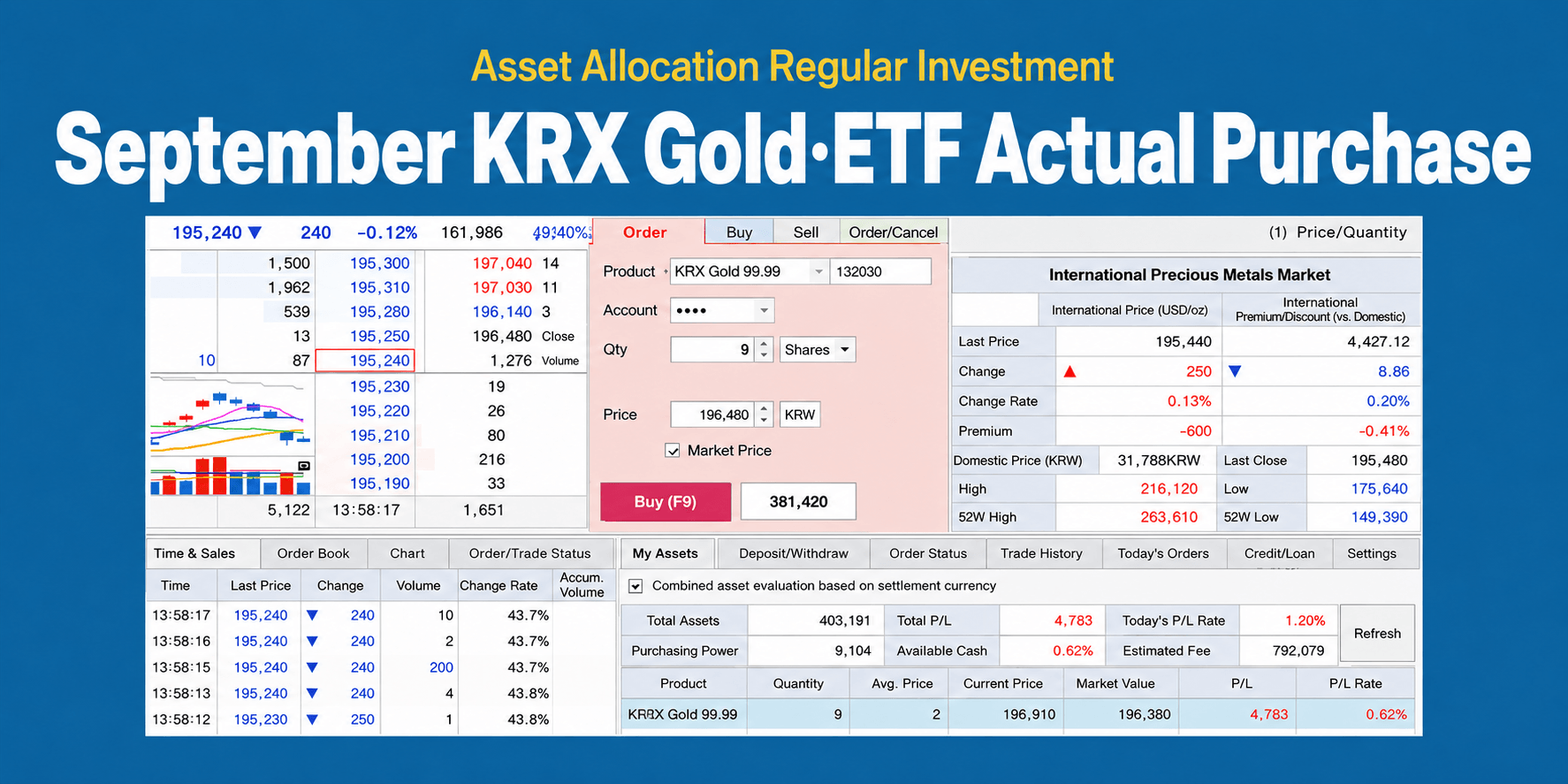
Market timing remains one of the most persistent illusions in personal wealth management. Long-term wealth accumulation is governed not by predicting macroeconomic inflection points, but by adhering to an unwavering, rules-based accumulation framework. On September 1, 2026, we executed our scheduled monthly capital deployment under the structured Asset Allocation DCA Portfolio framework. By systematically deploying KRW 1,985,235 (approximately $1,470 USD) across domestic core index trackers, precious metals, dividend growers, and liquid liquidity buffers, this institutional-grade retail strategy demonstrates the power of disciplined execution over emotional speculation.
For an in-depth breakdown of our foundational asset weighting architecture and historical backtesting simulations, review our comprehensive framework in our Asset Allocation DCA Portfolio Simulation & Backtesting Model.
“True long-term compounding does not require forecasting market regimes. It demands an automated system that accumulates undervalued units across non-correlated asset classes with absolute mathematical discipline.”
Asset Allocation DCA Portfolio: September 2026 Execution Breakdown
Systematically managing an Asset Allocation DCA Portfolio requires strict capital discipline and predefined mathematical parameters. This Asset Allocation DCA Portfolio structure is designed to mitigate sequence-of-returns risk through continuous, programmatic dollar-cost averaging across all four non-correlated asset pillars.
The Asset Allocation DCA Portfolio is engineered to balance equity compounding, inflation defense, cash flow reinvestment, and capital preservation. Because exchange-traded funds (ETFs) and spot commodities trade in integer unit tranches, minor variances from exact currency allocations are standard. Total capital deployed for this monthly tranche settled at KRW 1,985,235.
| Asset Class & Instrument | Execution Unit Price | Quantity | Total Outlay (KRW / USD Est.) | Target Allocation | Portfolio Role |
|---|---|---|---|---|---|
| TIGER U.S. S&P500 ETF (360750) | KRW 26,170 | 46 Units | KRW 1,203,820 ($891.70) | 60.6% | Core Growth Engine |
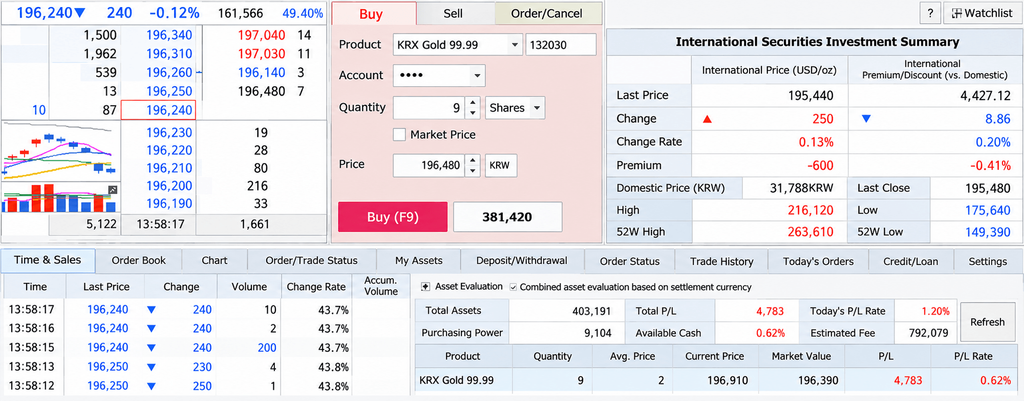
| KRX Physical Gold Spot (99.99_1kg) | KRW 196,400 / 1g | 2g | KRW 392,800 ($290.95) | 19.8% | Inflation & Volatility Hedge |
| TIGER U.S. Dividend Dow Jones ETF (458730) | KRW 15,145 | 13 Units | KRW 196,885 ($145.85) | 9.9% | Dividend Cash Flow Compounder |
| KODEX U.S. Money Market Active ETF (0048J0) | KRW 13,695 | 14 Units | KRW 191,730 ($142.00) | 9.7% | Liquidity Buffer & Yield Parking |
| Total Monthly Execution | — | 75 Units / Grams | KRW 1,985,235 ($1,470.50) | 100.0% | Target Met with <0.6% Variance |

Fundamental Analysis of the 4 Core Pillar Assets
Every allocation inside this portfolio performs an uncorrelated macroeconomic function. Maintaining disciplined weights prevents overall equity drawdowns from derailing the 30-year compounding trajectory.
1. S&P 500 Index: Capital Expansion Core (60% Target)
Tracking the 500 leading publicly traded U.S. corporations provides unfiltered exposure to global corporate revenue and productivity expansion. As highlighted in broad macroeconomic benchmarks on Investing.com Market Indices, the S&P 500 historically delivers annualized nominal returns near 10%, serving as the non-negotiable bedrock of wealth generation.
2. KRX Physical Gold Spot: Uncorrelated Inflation Defense (20% Target)
Physical gold serves as the ultimate store of value during real-rate compression and fiat currency debasement. By acquiring physical grams through the domestic exchange rather than futures contracts, the portfolio avoids contango drag and capital gains taxation, providing a frictionless hedge against equity drawdowns.
3. U.S. Dividend Dow Jones: Cash Flow Generation (10% Target)
Targeting top-tier dividend-growing companies with robust balance sheets (tracking the Dow Jones U.S. Dividend 100 Index framework), this allocation cushions downside volatility. Furthermore, growing cash distributions provide organic internal liquidity that is systematically reinvested each month.
4. Active U.S. Money Market: Liquidity Buffer & Capital Preservation (10% Target)
Allocating capital to ultra-short duration sovereign bills captures risk-free baseline interest income. Additionally, this cash proxy creates a tactical reserve to opportunistically accumulate depreciated risk assets during cyclical equity market corrections.

Overcoming Short-Term Paper Drawdowns: The Mathematical DCA Advantage
Our inaugural settlement period in August registered a minor paper deficit of -0.38% (KRW -12,173). While inexperienced investors often perceive minor drawdowns as structural failure, seasoned allocators recognize negative volatility during early accumulation stages as a distinct mathematical advantage.
Through Dollar-Cost Averaging (DCA), deploying a fixed cash outlay into depreciated prices acquires a greater volume of asset units. When markets eventually mean-revert upward, accumulated low-cost unit density exponentially boosts long-term portfolio velocity. Systematic unit acquisition—not temporary mark-to-market valuation—drives generational compounding over a 30-year horizon.
Ultimately, the core objective of the Asset Allocation DCA Portfolio is multi-decade unit accumulation rather than short-term mark-to-market performance. Over a 30-year compounding horizon, an Asset Allocation DCA Portfolio allows investors to capture underlying economic expansion while the Asset Allocation DCA Portfolio strategy systematically shields the overall balance from localized market drawdowns.
30-Year Portfolio Execution Rules
To insulate this strategy from behavioral biases, our investment process adheres to three mandatory rules:
- Complete Timing Neutrality: Capital deployments occur automatically on the 1st of every calendar month, completely disregarding market headlines, sentiment indices, or technical momentum.
- Account-Level Tax Optimization: Equity-linked and dividend ETFs reside within tax-sheltered Individual Savings Accounts (ISA), ensuring complete exemption and low-rate separate taxation, while spot gold trades via tax-free spot bullion accounts.
- 100% Reinvestment of Capital Yields: All distributions, interest payments, and surplus cash balances are automatically rolled into the subsequent month’s execution capital without leakage.
By executing these foundational principles monthly, the Asset Allocation DCA Portfolio systematically converts short-term market noise into enduring, multidecade financial independence.
Frequently Asked Questions (FAQ)
How do you manage cash remainder when ETF unit prices prevent exact allocation matching?
Because ETFs and spot gold trade in discrete whole units, rounding variances are natural. Fractional cash residuals remain in the money market account and automatically roll into the capital pool for the following month’s tranche, maintaining long-term target equilibrium.
Why allocate physical gold rather than equity gold mining stocks or futures?
Physical spot gold incurs zero corporate balance sheet risk, avoids rolling contango decay associated with commodity futures, and provides genuine non-correlated downside protection during global liquidity crunches.
How does Dollar-Cost Averaging (DCA) outperform lump-sum investing during volatile regimes?
While lump-sum capital deployment maximizes equity exposure during structural bull markets, DCA eliminates catastrophic sequence-of-returns risk. DCA guarantees psychological discipline and lowers the average cost basis throughout prolonged market consolidations.