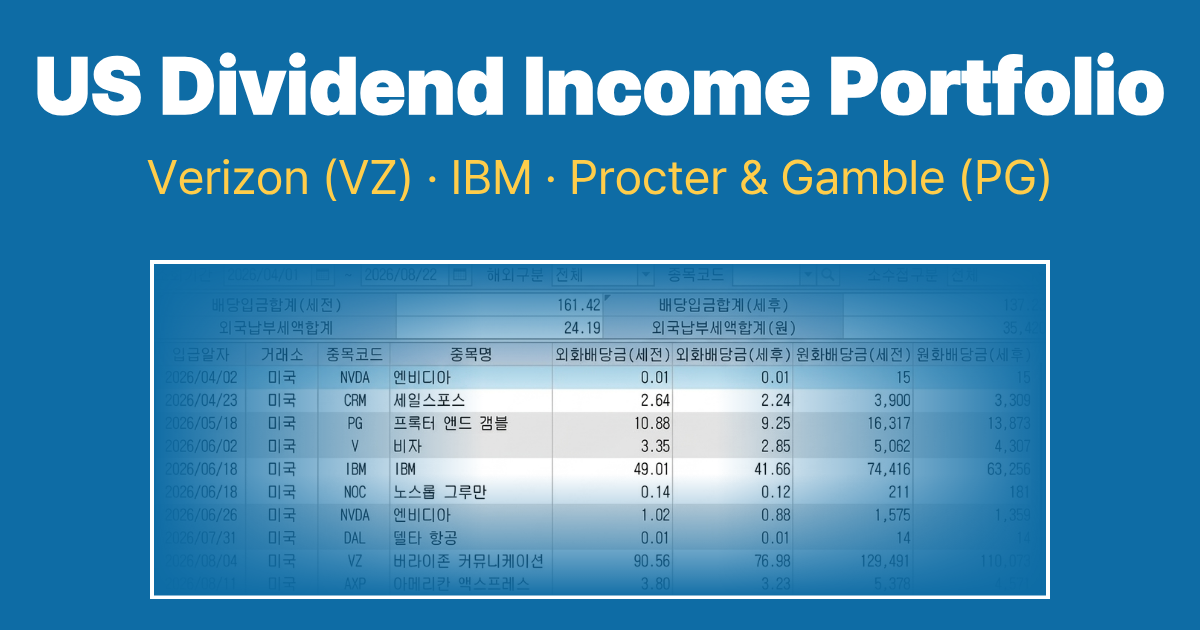
Building a robust, self-sustaining US dividend income portfolio serves as a premier cornerstone for global investors seeking financial independence and predictable quarterly cash flow. Rather than chasing elusive short-term speculative momentum, allocating capital into seasoned corporations with proven dividend distributions establishes a reliable defensive barrier against broader market turbulence.
A resilient US dividend income portfolio requires balancing current high yield with conservative capital protection. In this deep fundamental breakdown, we examine three foundational dividend leaders—Verizon Communications (VZ), International Business Machines (IBM), and Procter & Gamble (PG)—assessing payout stability, business moats, and reinvestment dynamics for global portfolios.
“True dividend investing is not merely about pursuing the highest yield on paper; it is about securing distributions backed by durable operating cash flow and disciplined balance sheet stewardship.”
1. Strategic Allocation Framework for a US Dividend Income Portfolio
Achieving sustainable total return without succumbing to yield traps requires sector diversification. A resilient US dividend income portfolio blends telecommunications infrastructure, enterprise computing, and indispensable consumer staples.
Each of these three assets fulfills a specific strategic role within a balanced passive income framework:
- Verizon Communications (NYSE: VZ): High-Yield Anchor delivering defensive, subscription-backed telecom cash flow to boost portfolio yield.
- International Business Machines (NYSE: IBM): Hybrid Transformation Engine offering attractive income paired with software and hybrid cloud growth catalysts.
- Procter & Gamble (NYSE: PG): Defensive Aristocrat providing unparalleled pricing power and multi-decade dividend growth continuity.
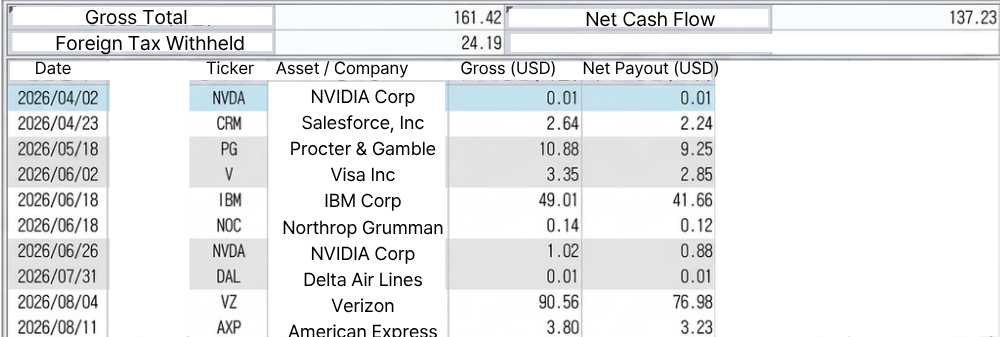
To visualize how these dividend engines integrate into a diversified US dividend income portfolio, examine the structural allocation below:
2. Fundamental Analysis: Core Holdings Breakdown
Let us analyze the individual operational health, dividend payout ratios, and balance sheet foundations of each asset comprising our US dividend income portfolio model.
Verizon Communications (VZ): Pure Cash Generation vs. Debt Burden
Verizon represents a classical high-yield cash machine. As one of North America’s premier wireless telecom operators, Verizon commands predictable recurring subscriber revenue. Telecommunications services operate as modern utility essentials, insulating operating revenue from cyclical recessions.
However, running a nationwide broadband and 5G network demands massive capital expenditures (CapEx). While the dividend yield remains significantly elevated, investors must monitor debt maturity profiles and spectrum amortization schedules. Operating free cash flow comfortably covers the distribution, preserving Verizon’s status as a critical cash-flow engine for income seekers managing a US dividend income portfolio.
IBM: Transitioning from Legacy Hardware to Hybrid Cloud
International Business Machines has successfully executed a structural transformation, spinning off legacy managed infrastructure to focus intensely on Red Hat, open hybrid cloud platforms, and enterprise artificial intelligence solutions. This strategic pivot has fundamentally stabilized revenue trajectories.
IBM’s dividend payout is supported by expanding software recurring revenues and stable enterprise consulting contracts. By modernizing its product catalog while maintaining dividend discipline, IBM functions as an attractive middle-ground candidate combining high single-digit yield characteristics with steady capital retention within an enterprise-focused US dividend income portfolio.
Procter & Gamble (PG): The Ultimate Defensive Dividend King
Procter & Gamble stands as one of the most celebrated Dividend Kings in global capital markets, having increased its cash distribution annually for over six consecutive decades. Its deep portfolio of consumer staple brands grants PG immense pricing elasticity during inflationary periods.
Although its baseline dividend yield is lower compared to high-yield telecom plays, PG’s conservative payout ratio, stellar return on invested capital (ROIC), and pristine balance sheet make it the anchor asset that mitigates drawdown volatility across broad market corrections.
3. Key Financial Metrics and Dividend Profile Comparison
The operational metrics below illustrate how diversifying across yields and payout ratios optimizes income generation across a US dividend income portfolio based on historical financial tracking (Source: Investing.com market benchmarks).
| Stock / Ticker | Sector Category | Target Dividend Yield | Payout Stability Tier | Primary Portfolio Role |
|---|---|---|---|---|
| Verizon (VZ) | Telecommunications | 6.5% – 7.5% | Cash Flow Dependent | Immediate Cash Yield |
| IBM (IBM) | Enterprise Software | 3.5% – 4.5% | Moderate Growth | Balanced Yield & Tech |
| Procter & Gamble (PG) | Consumer Staples | 2.3% – 3.0% | Dividend King / Highest | Capital Preservation |
4. Managing Drawdowns and Risk in a US Dividend Income Portfolio
Sustaining a long-term compounding strategy requires rigorous operational oversight. As outlined in our previous review on foundational core asset allocation models, passive income strategies require systematic risk management rather than static holding.
When executing a long-range US dividend income portfolio, observe the following execution guidelines:
- Free Cash Flow (FCF) Coverage Auditing: Ensure accounting earnings (EPS) are not masking weak cash flows. FCF must comfortably exceed quarterly distribution obligations.
- Reinvestment Automation (DRIP): Compounding dividend payouts automatically purchases fractional shares during downturns, accelerating long-term equity accumulation across your US dividend income portfolio.
- Periodic Valuation Rebalancing: Rebalance positions when one asset becomes substantially overvalued relative to historical yield bands, reallocating proceeds into undervalued peers.
- Tax-Efficient Asset Placement: Utilize dedicated investment accounts to optimize dividend withholding taxes, protecting net cash flow from excessive tax drag.
5. Dividend Growth vs. High Current Yield Trade-Off
A frequent dilemma when assembling a US dividend income portfolio is deciding between high immediate yield and rapid dividend growth. High-yield securities like Verizon provide strong baseline cash flow from day one, which can be immediately redirected into living expenses or reinvested. However, their dividend growth rate often hovers in the low single digits.
Conversely, dividend growth champions like Procter & Gamble may offer a modest initial yield, but their consistent mid-to-high single-digit dividend increases compound purchasing power over time. A balanced US dividend income portfolio harmonizes both approaches: using high-yield cash engines to accelerate compounding in early accumulation phases, while anchoring the principal with dividend growth aristocrats.
6. Long-Term Rebalancing and Cash Flow Maintenance
Maintaining portfolio equilibrium requires periodic reviews rather than emotional trading. Market price swings will inevitably skew your targeted allocation weights. For example, if tech shares surge while telecom lags, your high-yield engine’s weight may shrink relative to total asset value.
To preserve balance within your US dividend income portfolio, consider a two-tier rebalancing framework:
- Organic Rebalancing with New Capital: Direct incoming monthly contributions and accumulated quarterly dividend payments toward the underweight asset class, avoiding taxable sales.
- Threshold-Based Annual Rebalancing: If an individual asset deviates by more than 5% to 10% from its strategic target, execute a targeted partial trim to restore the baseline target weights.
Maintaining this disciplined structure ensures consistent financial yield while reducing exposure to market-wide volatility throughout your investing journey.
7. Frequently Asked Questions
What is the ideal allocation balance for a dividend portfolio?
A balanced strategy distributes capital across pure high-yield income drivers (such as Verizon), dividend growth compounders (such as IBM), and defensive preservation blue chips (such as Procter & Gamble), typically adjusting weights to personal cash flow requirements.
How does inflation affect dividend income assets?
Inflation impacts companies unevenly. Consumer staple leaders like Procter & Gamble pass input cost increases to consumers, while capital-intensive firms with elevated debt must navigate higher borrowing rates. Diversification across business models hedges this exposure.
Why is dividend reinvestment (DRIP) essential?
Reinvesting dividends harnesses the mathematical mechanics of compounding. By buying additional shares systematically through price swings, investors expand their base share count, increasing future dividend payouts exponentially over time.
This article is prepared for informational and educational purposes only and does not constitute financial, investment, or legal advice. Historical dividend payments and yields do not guarantee future performance. Investors should conduct independent research or consult a certified financial advisor before executing investment transactions.