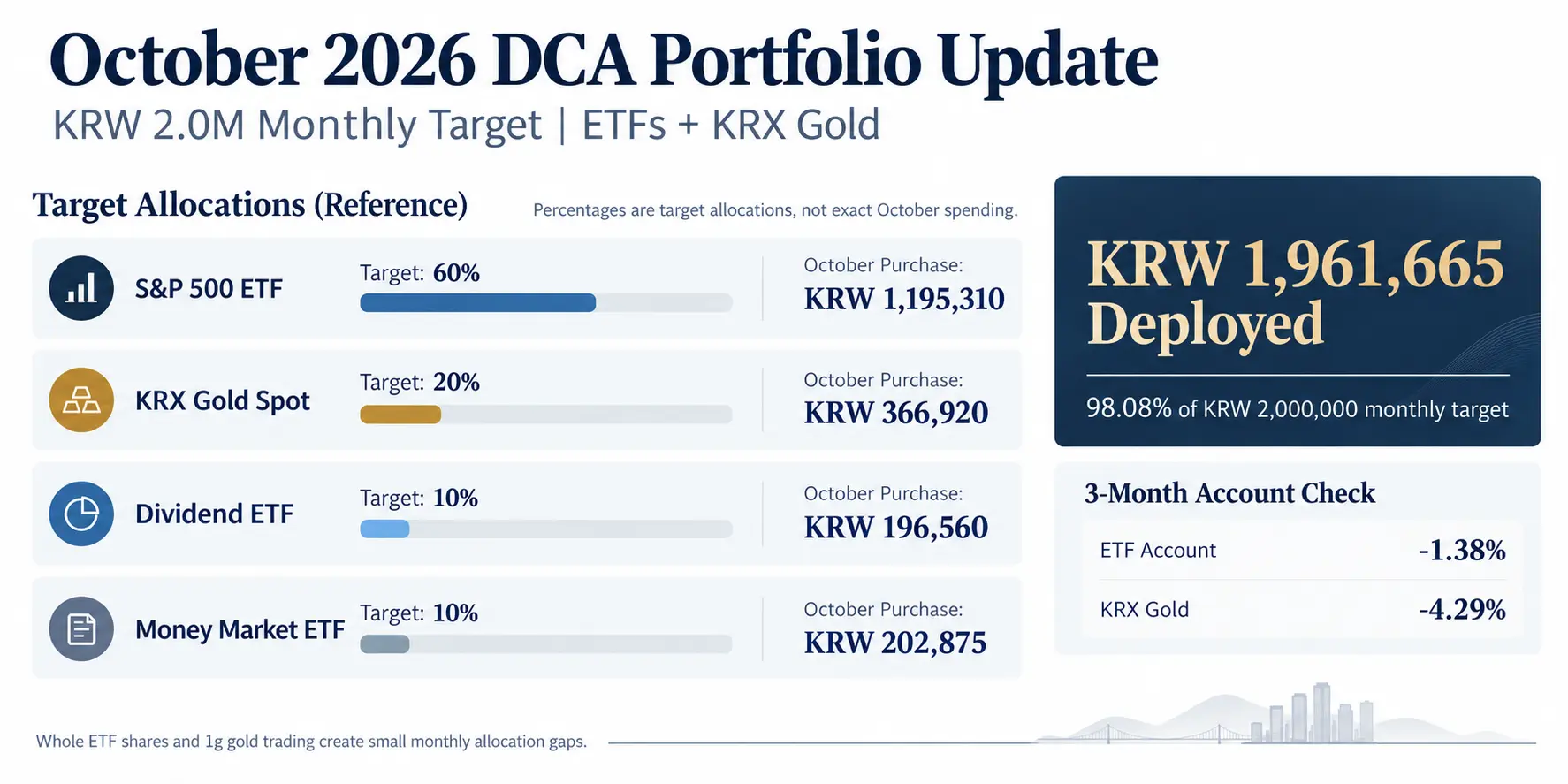
Exact target weights look clean on a spreadsheet, but a real monthly contribution rarely lands on them perfectly when ETFs trade in whole shares and gold trades in fixed units. My October 2026 contribution is a useful example.
This is the third month of my monthly DCA portfolio update. The monthly target remains KRW 2,000,000, allocated 60% to an S&P 500 ETF, 20% to KRX spot gold, 10% to a U.S. dividend ETF, and 10% to a money market ETF. These are Korea-listed instruments used to build U.S.-market exposure alongside exchange-traded gold.
After the October 1 purchases, I deployed KRW 1,961,665, or 98.08% of the monthly target. The remaining KRW 38,335 was not the result of a market-timing decision. It was simply the residual created by whole-share ETF trading and 1g gold trading.
For comparison, the previous month’s transactions are documented in the September 2026 asset-allocation DCA portfolio update.
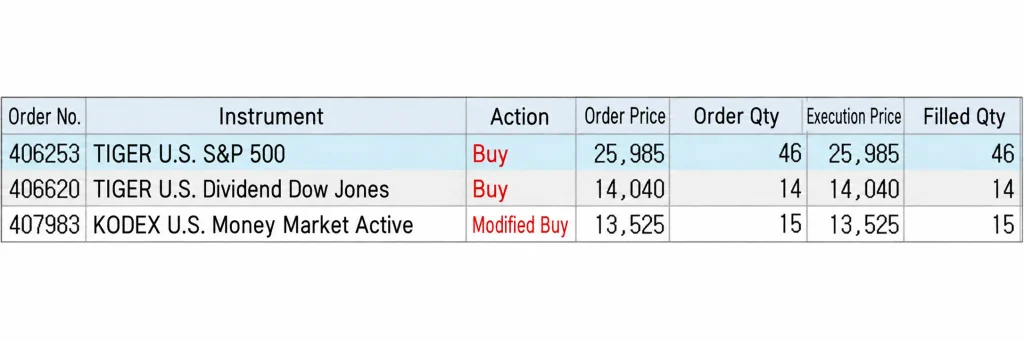
Monthly DCA Portfolio Update: October Trade Log
The ETF sleeve received KRW 1,594,745, while KRX gold received KRW 366,920. The S&P 500 and dividend positions came in slightly below their monthly targets, while the money market ETF ended slightly above its KRW 200,000 target.
| Investment | Monthly Target | Execution Price | Quantity | Actual Outlay | Difference |
|---|---|---|---|---|---|
| TIGER U.S. S&P 500 | KRW 1,200,000 | KRW 25,985 | 46 shares | KRW 1,195,310 | -KRW 4,690 |
| KRX Gold Spot | KRW 400,000 | KRW 183,460/g | 2g | KRW 366,920 | -KRW 33,080 |
| TIGER U.S. Dividend Dow Jones | KRW 200,000 | KRW 14,040 | 14 shares | KRW 196,560 | -KRW 3,440 |
| KODEX U.S. Money Market Active | KRW 200,000 | KRW 13,525 | 15 shares | KRW 202,875 | +KRW 2,875 |
| Total | KRW 2,000,000 | – | – | KRW 1,961,665 | -KRW 38,335 |
The three ETF purchases alone came within KRW 5,255 of their combined KRW 1.6 million target. Most of the month’s underinvestment came from the gold allocation because the next available 1g unit would have pushed that sleeve well above its planned amount.
Why Leaving KRW 38,335 Uninvested Was Acceptable
My goal is to stay close to the 60:20:10:10 allocation, not to force every monthly contribution to equal KRW 2,000,000 down to the last won.
The October spending represented approximately 59.77% of the monthly target in the S&P 500 ETF, 18.35% in gold, 9.83% in the dividend ETF, and 10.14% in the money market ETF. The uninvested balance was about 1.92% of the monthly contribution target.
The gold sleeve makes the rounding issue especially clear. KRX Gold Market orders are placed in 1g units. At my October execution price of KRW 183,460 per gram, 2g cost KRW 366,920. Buying 3g instead would have required KRW 550,380, which would have moved the position much farther from its KRW 400,000 monthly target.
The Korea Exchange describes the KRX Gold Market trading unit as 1g in its official KRX Gold Market guide.
My Gold Execution Price Fell 6.59% From September
One month-over-month change was noticeable in the gold sleeve. My September execution price was KRW 196,400 per gram, while the October purchase was completed at KRW 183,460 per gram.
That is a 6.59% decline in my execution price per gram. Because I purchased 2g in both months, the October gold purchase required KRW 25,880 less capital than September. This explains most of the difference between the two months’ total deployed amounts without requiring any change to the 20% target weight.
This comparison is based on my own execution prices, not a claim about the percentage change in a broad international gold benchmark over the same period.
Three-Month Account Check: Both Sleeves Are Still Negative
After three months, neither the ETF sleeve nor the gold account is showing a positive return. The ETF account reports a total return of -1.38%, while the KRX gold account reports -4.29%.
| Account Sleeve | Cost Basis | Value Used in This Update | Reported P/L | Reported Return |
|---|---|---|---|---|
| ETF Account | KRW 4,789,818 | KRW 4,725,115 (brokerage market value) | -KRW 66,093 | -1.38% |
| KRX Gold | KRW 1,142,560 | KRW 1,093,488 (cost basis less reported P/L) | -KRW 49,072 | -4.29% |
The point of recording this stage is not to argue that a three-month result proves or disproves the allocation. It shows something more practical: diversification does not guarantee that every sleeve will offset another over short periods.
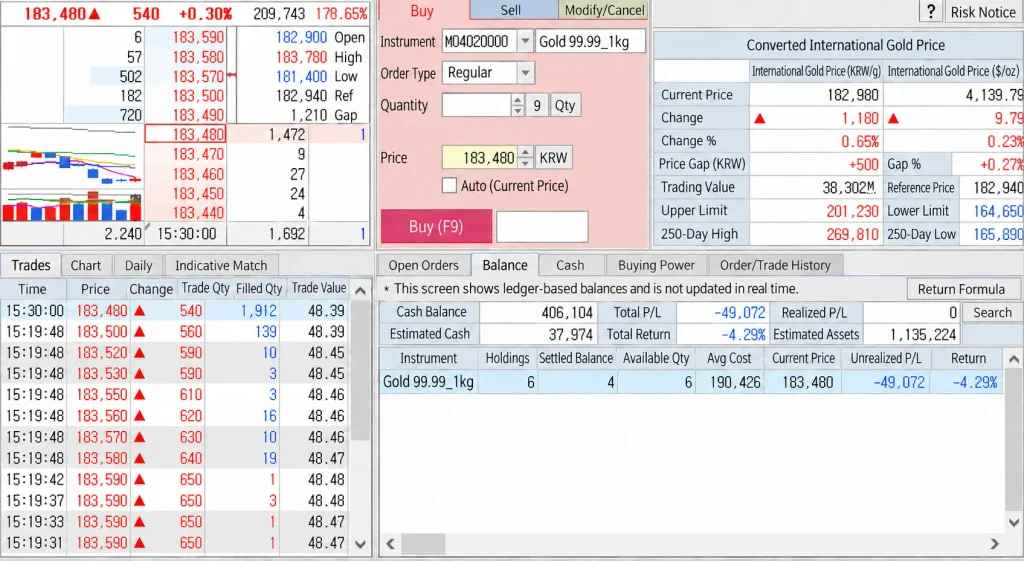
Gold Account After the October Purchase
The October purchase increased the KRX gold position to 6g. Using the recorded total cost basis of KRW 1,142,560 and the brokerage-reported P/L of -KRW 49,072 gives an implied account value of KRW 1,093,488 for this update.
The gold screenshot also shows a current price of KRW 183,480 per gram and an average cost of KRW 190,426, but those visible fields do not mechanically reconcile to the reported P/L. The balance screen itself states that it is ledger-based and not updated in real time, so I am preserving the broker-reported P/L rather than forcing a separate mark-to-market calculation.
ETF Account After the October Purchases
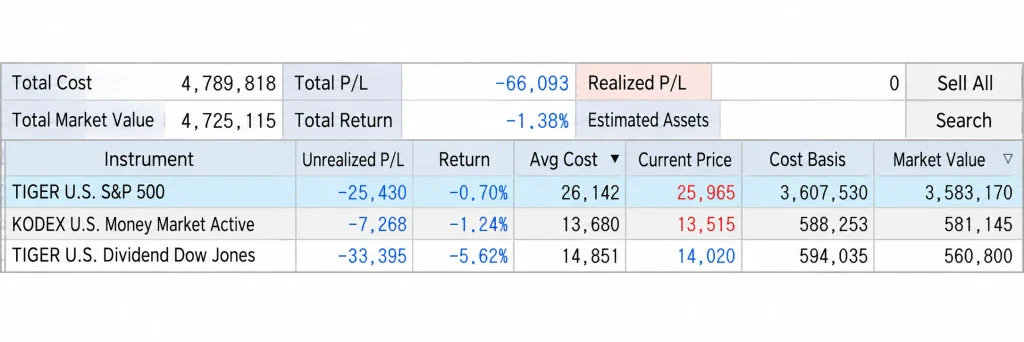
The ETF account shows KRW 4,789,818 in total cost and KRW 4,725,115 in market value. Among the three holdings, TIGER U.S. Dividend Dow Jones currently has the largest reported loss at -5.62%, compared with -0.70% for TIGER U.S. S&P 500 and -1.24% for KODEX U.S. Money Market Active.
Why I Am Preserving the Brokerage-Reported P/L
There is one reconciliation issue worth documenting rather than hiding. Subtracting the ETF account’s KRW 4,789,818 total cost from its KRW 4,725,115 market value produces -KRW 64,703. The brokerage screen, however, reports total P/L of -KRW 66,093.
The difference is KRW 1,390. The screenshot does not disclose enough information to determine exactly which brokerage calculation or account-level adjustment creates that gap. Rather than assume that it comes from fees, settlement adjustments, or another item, I am preserving the broker-reported total P/L and return as the account record.
This also makes future monthly comparisons more consistent: I can compare the same brokerage fields each month rather than changing the calculation method after the fact.
What This DCA Process Is Actually Testing
At this stage, the most useful information is not whether the portfolio is up or down after three months. It is whether the contribution process remains workable when returns are negative and exact target weights are impossible to hit.
- Small cash remainders are acceptable. I would rather leave KRW 38,335 uninvested than distort one allocation simply to reach a round KRW 2 million monthly total.
- Diversification does not eliminate short-term drawdowns. Both the ETF account and the gold sleeve are negative at the same time.
- The rules should change for structural reasons, not because of one weak month. A meaningful change in ETF strategy, fund costs, distribution policy, my investment horizon, or personal cash flow would justify a review. A temporary negative return by itself does not.
For the Korea-specific account structure behind the ETF sleeve, see the ISA ETF Tax Strategy Guide and real portfolio review. The ISA discussed there is a Korean account structure and should not be confused with a U.S. retirement account.
What I Will Track in November
The next monthly DCA portfolio update will use the same fields: execution price, quantity, actual amount invested, deviation from the target allocation, and brokerage-reported account returns.
Keeping the same measurement method matters more to this journal than trying to explain every short-term market move. Over a longer period, the record should make it easier to see whether the 60:20:10:10 contribution rule remains practical and whether any one sleeve persistently drifts away from its intended role.
Frequently Asked Questions
Why keep the portfolio figures in KRW instead of converting them to U.S. dollars?
The source brokerage accounts are denominated in Korean won, so keeping the figures in KRW preserves the original execution prices, cost basis, and account balances without introducing a second variable from currency conversion. A USD conversion could be useful for a separate comparison, but it is not necessary to evaluate whether the monthly allocation was executed as planned.
Why not force the remaining KRW 38,335 into one of the ETFs?
Doing so would make the monthly total look cleaner but could push one sleeve farther away from its intended weight. Because the plan is based on whole ETF shares and 1g gold units, a small residual balance is an expected part of the process.
Why does the ETF account’s reported P/L differ from market value minus cost?
The visible account data do not provide enough detail to identify the brokerage’s exact calculation method. The simple subtraction produces -KRW 64,703, while the brokerage reports -KRW 66,093. This article therefore preserves the brokerage-reported figure rather than assigning an unsupported explanation to the KRW 1,390 difference.
Investment Disclaimer: This article documents a personal investment process for educational and research purposes. It is not a recommendation to buy or sell any ETF, gold product, or other security. Account values and returns are based on records dated October 1, 2026 and may change afterward. Investment decisions and outcomes remain the responsibility of the investor.