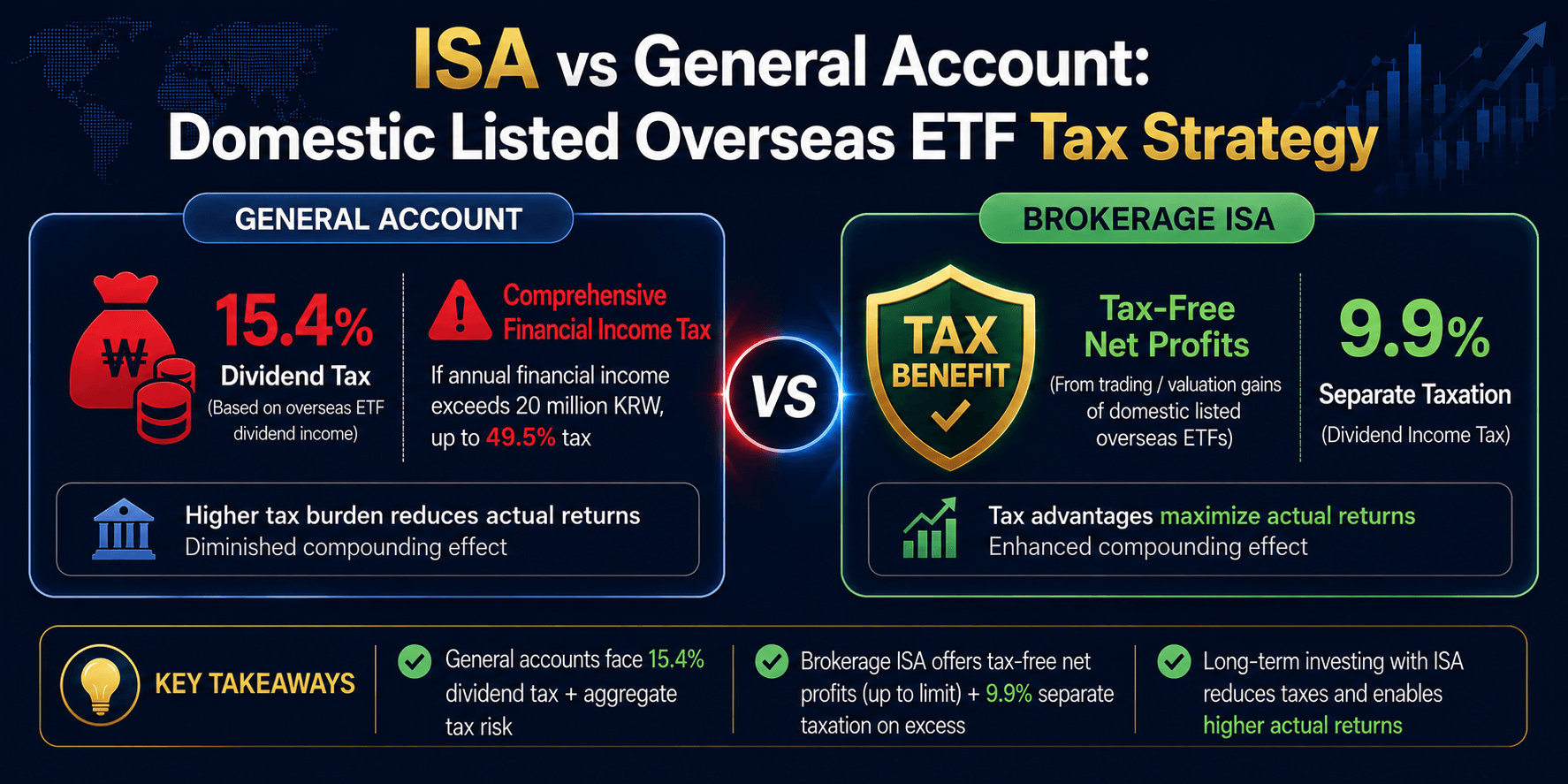
A South Korean Individual Savings Account can improve the tax treatment of certain investments, but the benefit is more specific than simply replacing a 15.4% tax rate with 9.9%. The result depends on the type of income generated inside the account, which gains and losses qualify for netting, the investor’s tax-free allowance, and how foreign taxes have already been collected inside an overseas-investing fund.
This article examines a Korea ISA ETF tax strategy using a real monthly allocation of KRW 1,600,000 across three Korea-listed ETFs with U.S. market exposure. The tax discussion is based on rules reviewed as of October 13, 2026.
Jurisdiction note: This article discusses South Korea’s Individual Savings Account system. It is not a U.K. ISA, a U.S. IRA, or another country’s retirement account.
For the broader portfolio allocation that includes assets held outside the ISA sleeve, see Asset Allocation DCA Portfolio: September 2026 Purchase & 30-Year Compounding Strategy.
How Korea’s ISA Tax Treatment Actually Works
Under South Korea’s current ISA rules, qualifying interest and dividend income generated inside the account is aggregated under the ISA tax framework. A tax-free allowance is applied to eligible net income, and qualifying income above that allowance is subject to separate taxation rather than being added to the ordinary comprehensive income tax base.
As of October 13, 2026, the tax-free allowance is generally KRW 2,000,000. Investors who meet the statutory income or agricultural and fishery requirements can qualify for a KRW 4,000,000 allowance. Income above the applicable allowance is taxed at a 9% national income-tax rate, commonly expressed as 9.9% including local income tax.
The statutory basis can be checked in Article 91-18 of Korea’s Restriction of Special Taxation Act.
This does not mean that every investment gain inside an ISA becomes either tax-free or taxable at 9.9%. Different securities produce different types of taxable and non-taxable income, and the ISA loss-netting rules do not treat every market gain or loss identically.
Why a Simple 15.4% vs. 9.9% Comparison Is Misleading
A common shortcut is to assume that a Korea-listed overseas ETF held in a regular brokerage account pays 15.4% on its entire market gain, while the same gain inside an ISA is taxed at 9.9%. That comparison is too simple.
For Korea-listed ETFs that fall outside the domestic-equity ETF category, the taxable amount on a sale can depend on both the actual trading gain and the increase in the fund’s tax-base price. According to the Korea Exchange, withholding on these ETFs is generally calculated using the smaller amount rather than automatically applying 15.4% to the entire market-price gain.
Korea Exchange ETF tax guidance provides the underlying framework for this distinction.
| Issue | Regular Brokerage Account | Korean ISA |
|---|---|---|
| Tax timing | Tax can be withheld when taxable ETF income or distributions are realized. | Eligible taxable income is generally deferred and settled under ISA rules at termination or another applicable settlement point. |
| Tax-free allowance | No ISA-specific KRW 2M or KRW 4M allowance. | KRW 2M generally, or KRW 4M for qualifying investors. |
| Income above allowance | Depends on the product and applicable income-tax rules. | Qualifying excess income is separately taxed at 9.9% including local income tax. |
| Loss netting | Depends on the security and tax category. | Eligible taxable gains and losses can be netted under ISA rules, but not every non-taxable gain or loss participates in the same way. |
| Foreign tax | Foreign withholding or fund-level foreign tax may still affect returns. | Foreign tax is not automatically eliminated. Special foreign-tax credit rules apply to qualifying fund and ETF income. |
A Better ISA Tax Example: Start With Eligible Net Income
Instead of assuming that an ETF’s full market gain is taxable, a cleaner ISA example begins after the account’s eligible taxable gains and losses have been determined under the applicable rules.
Suppose an investor finishes the relevant ISA settlement period with KRW 6,000,000 of eligible net taxable income. This is an illustration of the ISA tax calculation, not a statement that a KRW 6,000,000 market gain automatically produces KRW 6,000,000 of taxable income.
| ISA Type | Illustrative Eligible Net Income | Tax-Free Amount | Amount Subject to 9.9% | Illustrative Tax |
|---|---|---|---|---|
| General | KRW 6,000,000 | KRW 2,000,000 | KRW 4,000,000 | KRW 396,000 |
| Qualifying lower-income / eligible category | KRW 6,000,000 | KRW 4,000,000 | KRW 2,000,000 | KRW 198,000 |
The arithmetic is straightforward once eligible net taxable income is known. The difficult part is determining what income actually enters that taxable base. Product structure, tax-base price changes, distributions, losses and foreign-tax treatment can all affect the final result.
Loss Netting Has Limits
ISA loss netting is useful, but it should not be described as complete profit-and-loss offsetting across every asset in the account.
Korean financial-industry guidance distinguishes taxable income from gains and losses that are already non-taxable under ordinary tax rules. For example, gains on qualifying domestic-listed shares are generally non-taxable, so a loss in a category that is outside the relevant taxable-income calculation does not automatically offset every interest or dividend gain elsewhere in the ISA.
This distinction matters for ETF investors because the taxable amount of a Korea-listed overseas ETF can differ from the visible market-price gain or loss. The tax result should therefore be based on the product’s actual tax treatment rather than a portfolio-level market-return number alone.
Foreign Withholding Tax Did Not Disappear Inside the ISA
The treatment of foreign taxes is one of the most important updates missing from older ISA explanations.
Beginning July 1, 2025, South Korea introduced a foreign-tax credit process for foreign tax generated through funds and ETFs held in an ISA. Under current brokerage guidance, qualifying foreign tax accumulated from July 1, 2025 can be considered when the ISA is terminated, subject to the applicable limits and ordering rules.
The foreign-tax credit is not the same as saying that foreign dividends enter an ISA with no tax friction or that investors always reinvest 100% of gross foreign income.
Mirae Asset Securities’ foreign-tax notice explains the July 1, 2025 implementation and the limitation of the credit to the relevant separated income-tax amount.
The Real Portfolio Sleeve Used in This Analysis
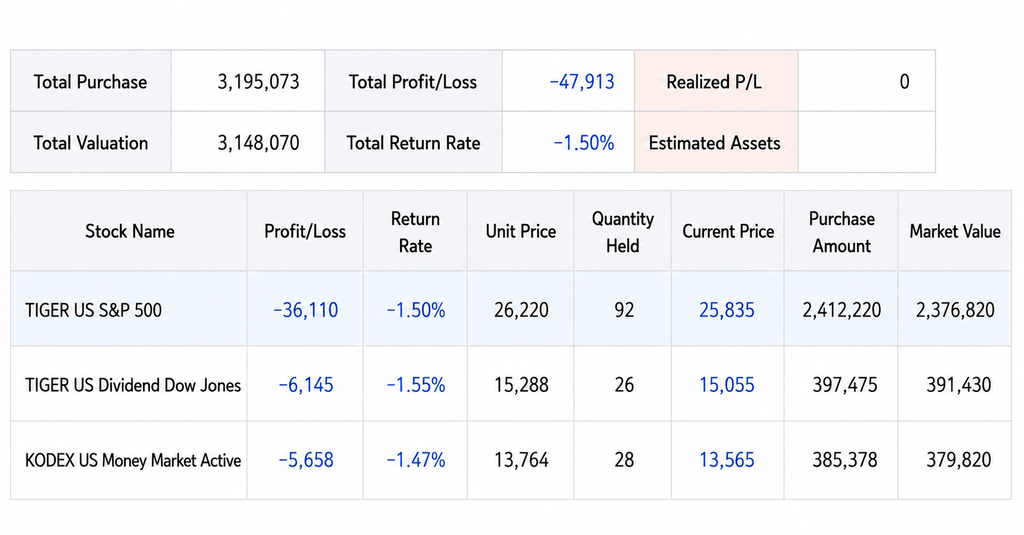
The documented strategy allocates KRW 1,600,000 per month to three Korea-listed ETFs inside the ISA-oriented portion of a broader multi-asset plan. The percentages below refer to the target weights of the full monthly portfolio, not percentages of the KRW 1,600,000 ISA sleeve itself.
| Investment | Monthly Target | Weight in Full Monthly Plan | Role |
|---|---|---|---|
| TIGER U.S. S&P 500 ETF | KRW 1,200,000 | 60% | Core U.S. equity exposure |
| TIGER U.S. Dividend Dow Jones ETF | KRW 200,000 | 10% | Dividend-oriented U.S. equity exposure |
| KODEX U.S. Money Market Active ETF | KRW 200,000 | 10% | Short-duration liquidity allocation |
| Total ETF sleeve | KRW 1,600,000 | 80% | ISA-focused portion of the broader plan |
At KRW 1,600,000 per month, annual contributions to this sleeve equal KRW 19,200,000 before any other ISA deposits. That is below the current general annual ISA contribution limit of KRW 20,000,000, although actual available contribution capacity depends on prior deposits and carried-forward unused limits.
A 30-Year Compounding Illustration Without a False Tax-Savings Estimate
The original version of this analysis applied 15.4% and 9.9% directly to projected long-term portfolio gains. That method overstates the precision of the tax comparison because market gains are not necessarily identical to taxable ETF income in either account structure.
A more defensible calculation is to separate the investment-growth illustration from the tax calculation.
Assume KRW 1,600,000 is contributed at the end of every month and the portfolio earns a hypothetical annual return of 8%, compounded monthly. Under those assumptions, the gross accumulation before fees, taxes, tracking differences and other real-world frictions is:
| Horizon | Cumulative Contributions | Illustrative Gross Value | Illustrative Growth Above Contributions |
|---|---|---|---|
| 10 years | KRW 192.0M | Approximately KRW 292.7M | Approximately KRW 100.7M |
| 20 years | KRW 384.0M | Approximately KRW 942.4M | Approximately KRW 558.4M |
| 30 years | KRW 576.0M | Approximately KRW 2.385B | Approximately KRW 1.809B |
These figures are a compounding illustration, not a forecast. An 8% return is an assumption rather than a guaranteed outcome, and the table intentionally does not claim a fixed 30-year ISA tax saving. The eventual tax result depends on the composition of returns, taxable distributions, product tax-base calculations, realized losses, foreign-tax credits and the ISA rules in effect when the account is settled.
Three Years Is a Minimum Holding Period, Not an Automatic Reset Rule
The Korean ISA has a three-year mandatory holding period for its tax benefits under the standard framework, but this does not mean every investor should automatically terminate the account on the 36-month anniversary and immediately open another one.
Current brokerage guidance allows an ISA to continue beyond the minimum holding period, and contract extensions or later re-enrollment may be available depending on the account and eligibility conditions. An investor may also have reasons to evaluate a retirement-account transfer after an eligible ISA termination.
The correct decision depends on the investor’s current tax-free allowance, unrealized positions, accumulated taxable income, contribution capacity, future eligibility and retirement-account plans. A mechanical three-year rolling cycle should therefore be treated as one possible planning choice rather than a universal rule.
Samsung Securities’ current ISA guide summarizes the three-year holding period, contribution limits, tax benefits and extension or re-enrollment framework.
Can You Buy U.S.-Listed ETFs Directly in a Korean ISA?
No. A Korean brokerage ISA does not allow direct trading in shares or ETFs listed on overseas exchanges. Investors who want S&P 500, U.S. dividend or U.S. money-market exposure inside the account generally use eligible Korea-listed products that provide the desired overseas exposure.
This distinction is important because a Korea-listed ETF that tracks U.S. assets is still a Korean-listed security for account eligibility and Korean tax administration. Its tax mechanics should not be confused with directly owning a U.S.-listed ETF in a regular overseas-stock brokerage account.
What the ISA Advantage Does and Does Not Do
The strongest case for the ISA is not that it makes every investment return tax-free. Its practical value comes from combining a tax-free allowance, separate taxation on qualifying excess income, tax deferral and eligible loss netting within one account structure.
Those benefits can reduce tax friction for investors holding taxable interest- or dividend-producing assets, including certain Korea-listed overseas ETFs. But the magnitude of the benefit varies by product and investor. A low-distribution equity ETF, a high-distribution ETF and a money-market product can generate very different taxable-income patterns even when their market values grow by similar percentages.
For that reason, a sound Korea ISA ETF tax strategy starts by identifying what each product actually generates for Korean tax purposes. The account type comes second. Projecting a fixed percentage tax saving from total portfolio gains can create false precision.
Frequently Asked Questions
Is all investment income inside a Korean ISA tax-free?
No. The applicable KRW 2,000,000 or KRW 4,000,000 allowance can make qualifying net income tax-free up to that amount. Qualifying income above the allowance is generally subject to 9.9% separate taxation including local income tax. Some gains may already be non-taxable under ordinary rules, while other income can follow product-specific tax treatment.
Does an ISA eliminate foreign withholding taxes on overseas-investing ETFs?
No. Foreign tax paid within funds and ETFs does not simply disappear because the investment sits in an ISA. Since July 1, 2025, a foreign-tax credit mechanism applies to qualifying foreign tax under specific limits when the ISA tax is settled. The final result depends on the composition of the account’s taxable income and the amount eligible for credit.
Should an investor automatically close and reopen an ISA every three years?
Not necessarily. Three years is the standard minimum holding period associated with the tax benefits, not a universal instruction to terminate the account every 36 months. Extension, termination, re-enrollment and possible retirement-account transfers should be evaluated using the rules and the investor’s circumstances at that time.
Bottom Line
A Korean ISA can be a useful tax wrapper for Korea-listed ETFs with overseas exposure, but its benefit cannot be measured by applying 9.9% to every portfolio gain and comparing that number with a blanket 15.4% taxable-account rate.
The more accurate process is to identify the security’s taxable income, determine which gains and losses qualify for ISA netting, apply the appropriate KRW 2,000,000 or KRW 4,000,000 exemption, account for foreign-tax rules where relevant, and then apply separate taxation to the remaining eligible income.
For the KRW 1,600,000 monthly ETF sleeve reviewed here, the ISA can reduce tax friction while preserving a simple recurring investment process. The exact lifetime benefit, however, will depend on future returns, distributions, tax-base calculations, account duration and tax law rather than a fixed 30-year savings figure.
Investment and Tax Disclaimer: This article is for educational and research purposes and is not a recommendation to buy or sell any security or individualized tax advice. Investment values can fall as well as rise. Korean ISA eligibility, tax treatment, contribution limits and foreign-tax rules may change after the October 13, 2026 review date. Investors should confirm current rules with the relevant financial institution or tax authority before making account or tax decisions.