US Stock Market Holidays 2026: Institutional Overview and Execution Realities
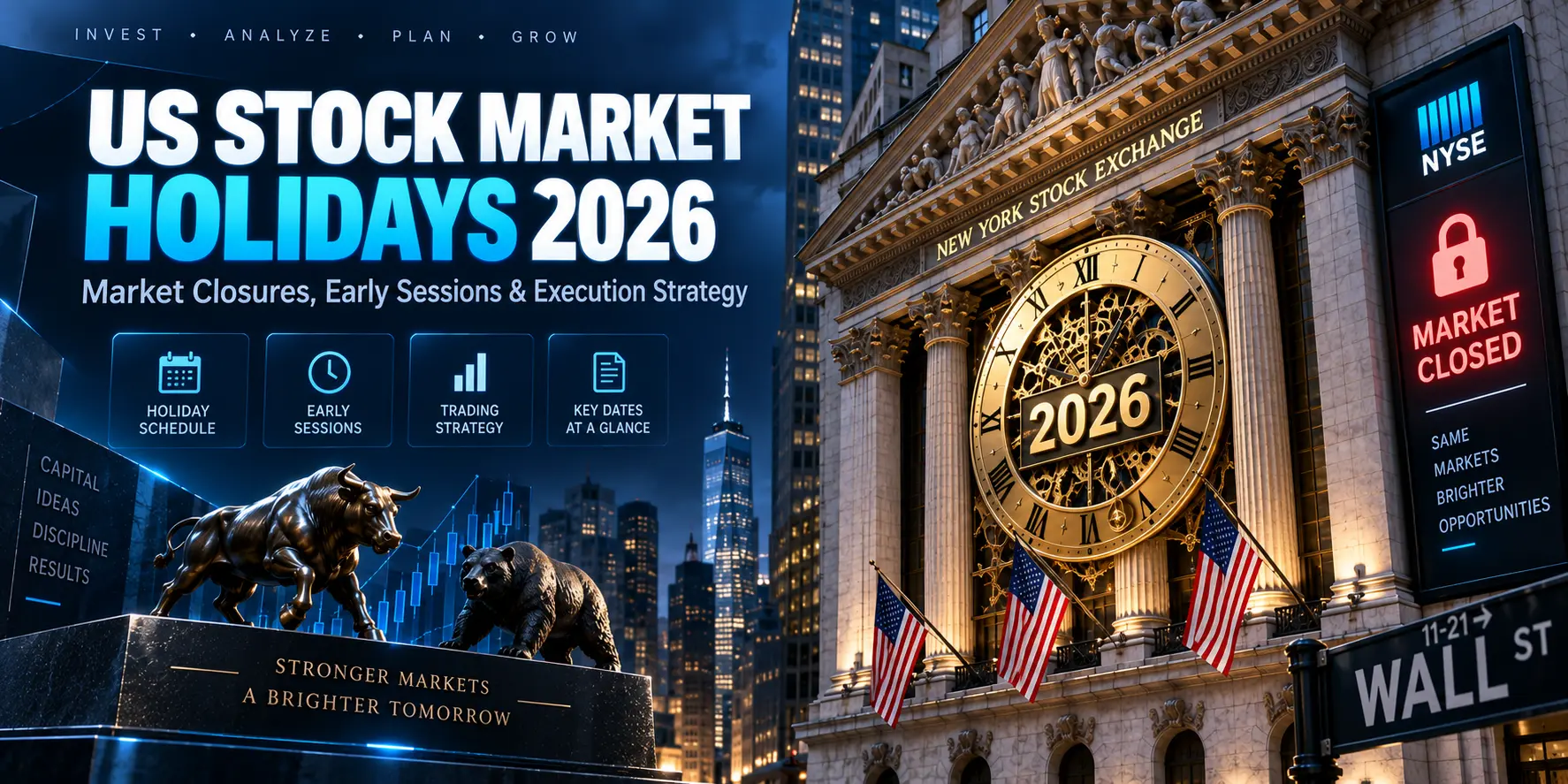
The US Stock Market Holidays 2026 schedule designates exactly ten full operational closures and two 1:00 PM EST early sessions across the New York Stock Exchange (NYSE) and Nasdaq. Navigating these scheduled trading halts requires disciplined capital allocation, proactive order management, and a comprehensive understanding of liquidity conditions during compressed settlement windows.
Scheduled exchange closures fundamentally alter market microstructure and shift global capital flows. Trading desks frequently observe wider bid-ask spreads and thinner order books during sessions immediately preceding federal holidays. Consequently, disciplined asset allocators utilize these operational pauses not for short-term speculative bets, but to evaluate corporate balance sheets and recalibrate long-term risk models.
When market depth thins ahead of extended holiday weekends, algorithmic matching engines can process large transactions with disproportionate market impact. Therefore, systematic investors must audit standing good-til-canceled (GTC) limit orders to mitigate the risk of unfavorable execution. Viewing exchange calendars as an essential execution roadmap helps preserve capital across seasonal liquidity cycles.
Long-term investment success is grounded in capital preservation and operational rigor. Utilizing exchange closures to audit portfolio balance and scrutinize free cash flow generation separates enduring allocators from emotional market participants.
H2 Schedule: Remaining US Stock Market Holidays 2026 and Early Closures
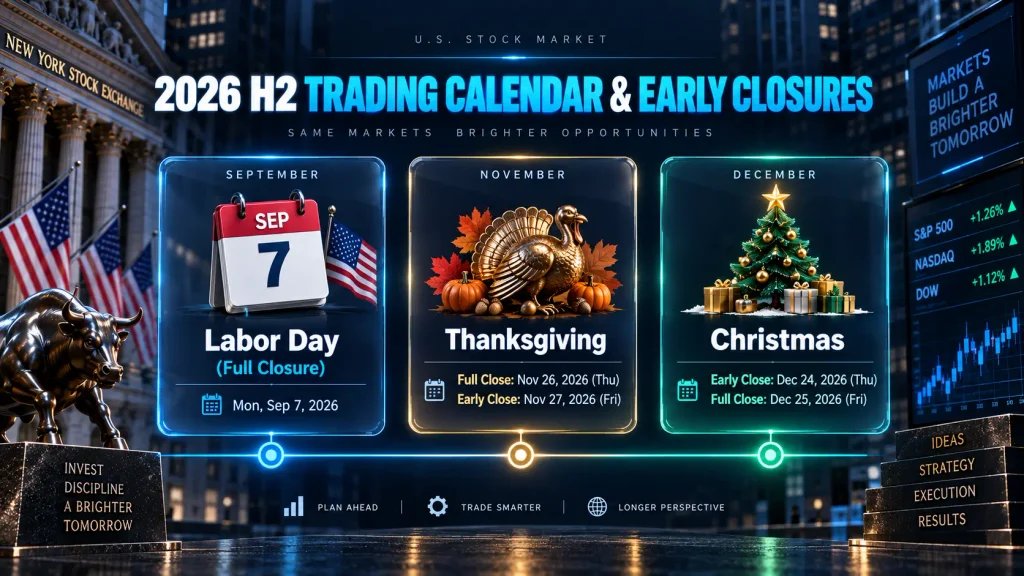
During the final four months of 2026, major American equity exchanges observe five operational schedule modifications. This remaining calendar includes three complete trading halts alongside two abbreviated sessions closing promptly at 1:00 PM Eastern Standard Time.
| Holiday Event | Date (2026) | Day of Week | NYSE & Nasdaq Status | Session Closing Time |
|---|---|---|---|---|
| Labor Day | September 7, 2026 | Monday | Full Market Closure | Closed All Day |
| Thanksgiving Day | November 26, 2026 | Thursday | Full Market Closure | Closed All Day |
| Black Friday | November 27, 2026 | Friday | Early Close Session | 1:00 PM EST (18:00 UTC) |
| Christmas Eve | December 24, 2026 | Thursday | Early Close Session | 1:00 PM EST (18:00 UTC) |
| Christmas Day | December 25, 2026 | Friday | Full Market Closure | Closed All Day |
Liquidity Compression, Auction Protocols, and SIFMA Bond Divergence
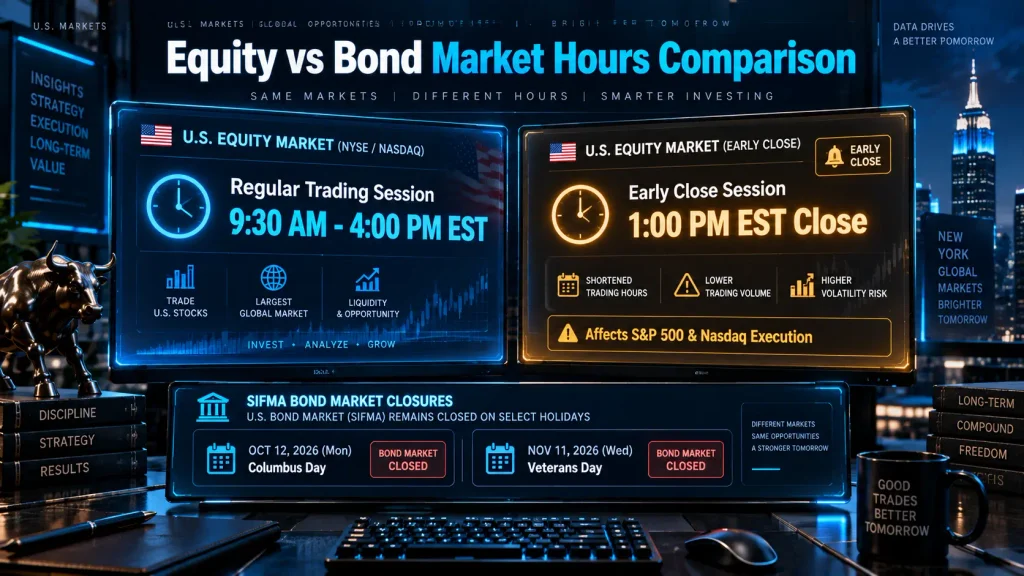
Shortened trading days introduce unique structural dynamics that institutional execution desks monitor closely. On November 27 and December 24, continuous trading halts at 1:00 PM EST rather than the standard 4:00 PM EST bell. As a result, institutional rebalancing volume compresses into an abbreviated closing cross, often resulting in heightened intraday price volatility.
Furthermore, equity market participants must account for calendar divergences between equity exchanges and fixed-income venues. The Securities Industry and Financial Markets Association (SIFMA) recommends full bond market closures on Columbus Day (October 12, 2026) and Veterans Day (November 11, 2026). However, both the NYSE and Nasdaq maintain normal equity trading hours on these federal holidays. Consequently, equity sectors trade without real-time Treasury yield discovery, occasionally exaggerating market dispersion.
To cross-examine verified exchange operating rules and settlement schedules directly, institutional allocators refer to the official NYSE Group Trading Hours and Calendar. Reviewing official filings confirms accurate settlement conventions across both primary sessions and secondary pre-market windows.
Valuation Discipline and Fundamental Rebalancing Bands
Operational downtime provides fundamental investors with an ideal opportunity to review intrinsic business value away from short-term ticker tape noise. Rather than anchoring to headline consensus price targets or unadjusted operating metrics, long-term allocators evaluate return on equity (ROE), operating margins, and true free cash flow durability. For a complete methodology on assessing corporate cash generation, explore our detailed analysis on how to calculate free cash flow and avoid net income traps.
Furthermore, establishing a quantitative stock fair value band during non-trading intervals helps mitigate behavioral errors when trading resumes. Having pre-calculated margin-of-safety thresholds enables systematic allocators to execute disciplined tranche purchases during macroeconomic gap-openings rather than reacting emotionally to broader market swings.
Institutional portfolio managers emphasize execution discipline regardless of temporary exchange closures. Understanding the annual trading rhythm allows long-term investors to manage liquidity reserves efficiently, ensuring operational pauses serve strategic asset allocation objectives.
Comprehensive US Stock Market Holidays 2026 Master Table
The NYSE and Nasdaq adhere to an identical schedule of ten recognized federal holidays. Under standard exchange rules, holidays falling on a Saturday are observed on the preceding Friday, while holidays falling on a Sunday are observed on the following Monday. In 2026, Independence Day (July 4, Saturday) is observed across all primary exchanges on Friday, July 3.
| Holiday Designation | Calendar Date | Day of Week | NYSE / Nasdaq Status | Settlement Impact |
|---|---|---|---|---|
| New Year’s Day | January 1, 2026 | Thursday | Full Market Closure | Standard Banking & Clearing Halt |
| Martin Luther King, Jr. Day | January 19, 2026 | Monday | Full Market Closure | DTCC Settlement Rollover |
| Washington’s Birthday (Presidents Day) | February 16, 2026 | Monday | Full Market Closure | DTCC Settlement Rollover |
| Good Friday | April 3, 2026 | Friday | Full Market Closure | Federal Reserve Open / Equities Closed |
| Memorial Day | May 25, 2026 | Monday | Full Market Closure | Standard Banking & Clearing Halt |
| Juneteenth National Independence Day | June 19, 2026 | Friday | Full Market Closure | DTCC Settlement Rollover |
| Independence Day (Observed) | July 3, 2026 | Friday | Full Market Closure | Standard Banking & Clearing Halt |
| Labor Day | September 7, 2026 | Monday | Full Market Closure | DTCC Settlement Rollover |
| Thanksgiving Day | November 26, 2026 | Thursday | Full Market Closure | Standard Banking & Clearing Halt |
| Christmas Day | December 25, 2026 | Friday | Full Market Closure | Standard Banking & Clearing Halt |
This master schedule highlights the direct operational link between exchange closures and clearinghouse settlement cycles. International allocators managing multi-currency accounts must incorporate these dates into their funding schedules to maintain uninterrupted trading access across both regular and extended-hours sessions.
Frequently Asked Questions (FAQ)
How does the US Stock Market Holidays 2026 schedule impact standing GTC limit orders?
Standing good-til-canceled (GTC) limit orders remain active in exchange order queues throughout market holidays without automatic cancellation. In contrast, standard day orders expire immediately upon the close of the trading session preceding the holiday. Prudent allocators frequently review resting orders against their updated asset fair value models prior to the market reopening.
What are the precise execution hours on early close trading days?
On early close dates (November 27 and December 24, 2026), the NYSE and Nasdaq conclude regular equity trading at 1:00 PM EST (18:00 UTC). Official closing crosses execute immediately at the 1:00 PM bell, while secondary after-hours trading sessions typically terminate by 5:00 PM EST rather than the customary 8:00 PM EST cutoff.
Are OTC equities and equity options bound by the same exchange calendar?
Yes. Over-the-counter (OTC) venues, the Chicago Board Options Exchange (CBOE), and all primary equity derivatives platforms observe the identical holiday schedule. On early close dates, single-stock options halt at 1:00 PM EST, while certain broad-based index options contracts conclude trading at 1:15 PM EST.
Investment Disclosure and Regulatory Disclaimer
This research report is provided solely for educational and operational planning purposes and does not constitute investment advice or a recommendation to buy or sell securities. Capital allocation involves risk of loss. Every investor must conduct independent due diligence or consult a licensed financial advisor before executing investment decisions.