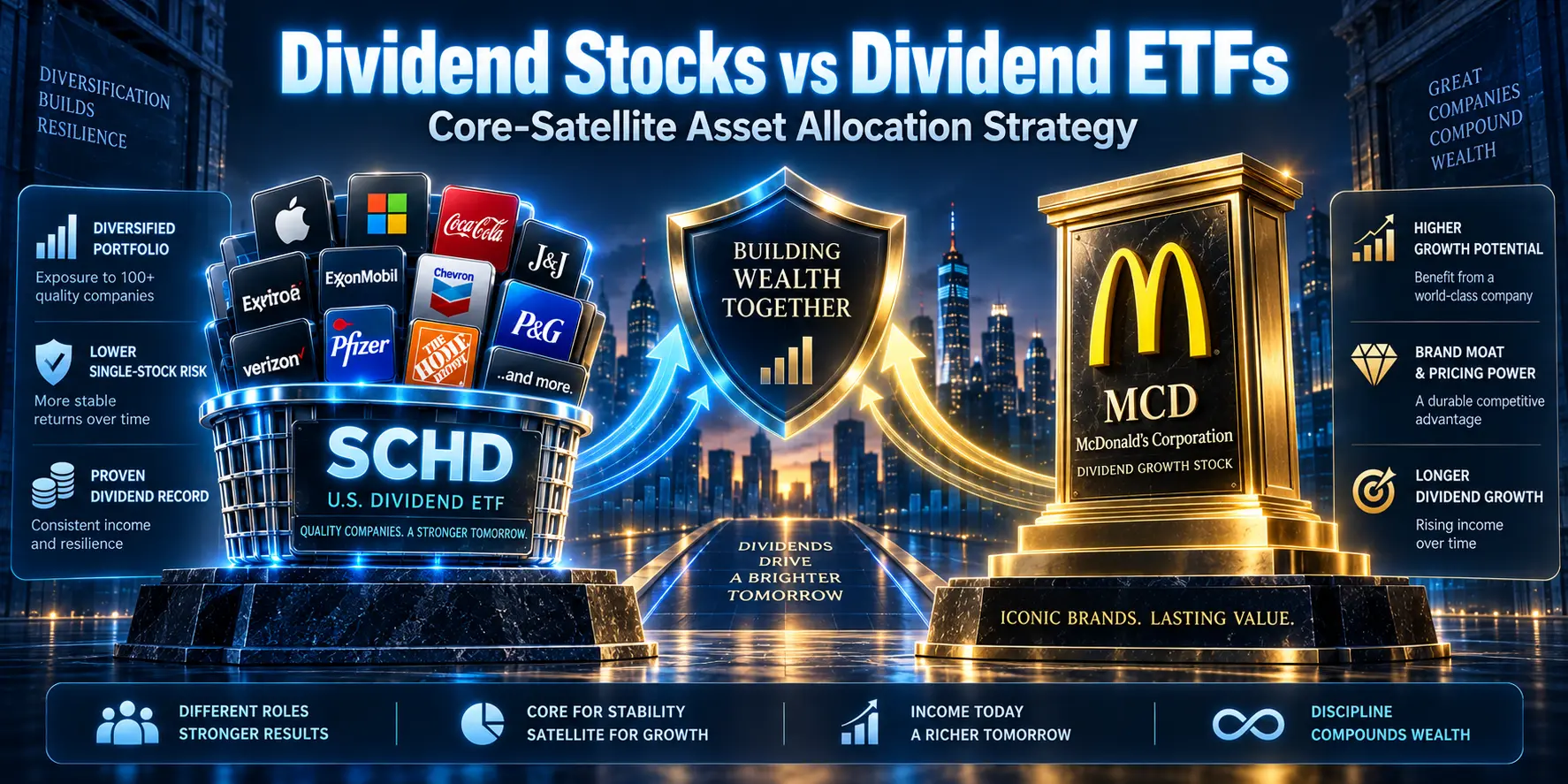
Dividend Stocks vs Dividend ETFs is not simply a choice between higher income and greater safety. The more useful question is how much company-specific risk, research responsibility, portfolio control, and diversification an investor wants to manage directly.
Owning individual dividend stocks gives an investor complete control over company selection, valuation, position size, and dividend quality. A dividend ETF spreads that exposure across many companies and applies a predefined index or portfolio methodology. That diversification can reduce the damage caused by one company’s dividend cut or business failure, but it does not eliminate market losses, sector concentration, dividend reductions, or methodology risk.
For long-term income investors, the two approaches can therefore serve different purposes. Some investors may prefer an ETF-only portfolio, some may be comfortable analyzing individual businesses, and others may combine the two. There is no universal allocation that is optimal for every investor.
Dividend Stocks vs Dividend ETFs: The Main Trade-Offs
The biggest difference is not the dividend yield itself. It is how risk and decision-making are distributed.
| Factor | Individual Dividend Stocks | Dividend ETFs |
|---|---|---|
| Company-specific risk | Direct exposure to each company’s earnings, debt, management, competitive position, and dividend policy. | Spread across multiple companies, reducing the impact of one holding without eliminating equity-market risk. |
| Portfolio control | High. The investor controls every holding and position size. | Lower. Holdings and weights follow the fund or index methodology. |
| Research burden | Requires company-level analysis and ongoing monitoring. | Lower company-level workload, although the ETF methodology, costs, and exposures still require review. |
| Fund expense | No ETF expense ratio, although brokerage, trading, and account costs may still apply. | Ongoing fund expenses apply. SCHD currently reports a 0.060% total expense ratio. |
| Dividend decisions | Each company can raise, maintain, reduce, suspend, or eliminate its dividend. | Fund distributions depend on income generated by the underlying portfolio and are not guaranteed. |
| Valuation control | The investor can avoid or add specific stocks based on valuation and business quality. | The investor buys the portfolio produced by the ETF’s methodology. |
As of October 12, 2026, Schwab reported 102 total holdings for the Schwab U.S. Dividend Equity ETF (SCHD). The fund currently reports a 0.060% total expense ratio and seeks to track the Dow Jones U.S. Dividend 100 Index.
Schwab’s official SCHD fund page provides current fund characteristics, expenses, holdings, and yield information.
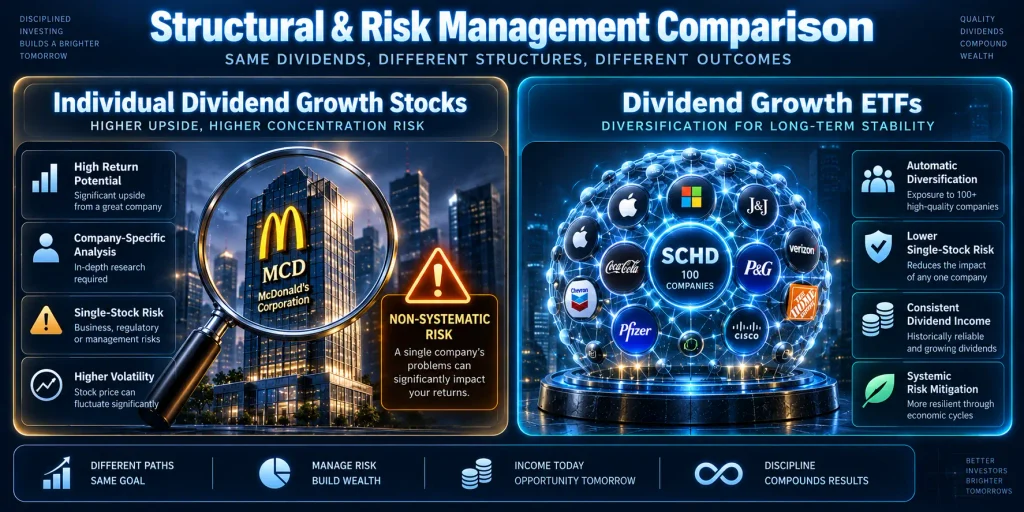
What ETF Diversification Solves — and What It Does Not
A dividend ETF can substantially reduce the effect of one company’s bankruptcy, accounting problem, dividend cut, or competitive decline. If one company represents only a small percentage of the fund, its deterioration generally has less impact than it would in a concentrated portfolio of a few stocks.
That is different from saying that an ETF eliminates business risk. A dividend ETF can still be concentrated in particular sectors, valuation factors, or investment styles. Its market value can decline during broad selloffs, and its distributions can fall if the underlying companies collectively generate less dividend income.
SCHD’s benchmark illustrates how a rules-based approach works. The Dow Jones U.S. Dividend 100 Index selects dividend-paying U.S. companies using dividend-history, liquidity, size, yield, and fundamental criteria. The index is rebalanced annually in March, while its methodology also includes ongoing dividend-related review.
The screening process includes a minimum history of cash-dividend payments and ranks eligible companies using factors that include cash flow relative to debt, return on equity, indicated dividend yield, and dividend growth. These rules can remove companies that no longer satisfy the methodology, but they do not guarantee stable distributions or superior future returns.
An ETF therefore changes the type of work the investor performs. Instead of analyzing every company’s financial statements in depth, the investor needs to understand the fund’s index rules, sector exposure, weighting method, costs, and distribution behavior.
When Individual Dividend Stocks Can Add Something Different
Individual stocks offer one advantage an ETF cannot fully replicate: the investor can decide exactly which company to own and at what valuation.
That flexibility can be useful when a financially strong business becomes temporarily cheaper, but a lower stock price or higher dividend yield is not enough by itself. A falling price may reflect deteriorating earnings, weakening cash generation, rising debt, competitive pressure, or a dividend that has become more difficult to fund.
Before treating a dividend stock as an attractive income opportunity, investors can examine operating cash flow, capital expenditures, free cash flow, dividend payments, debt obligations, and the underlying reason for the valuation decline.
The Smart Asset Desk free cash flow guide explains why accounting earnings and available cash can diverge and why cash generation matters when evaluating dividend capacity.
A company such as McDonald’s can be analyzed as an individual dividend holding, but a credible investment case should come from current business fundamentals and valuation rather than the assumption that a historically strong dividend payer will automatically recover after every decline.
A Core-Satellite Portfolio Is an Option, Not a Formula
One way to combine dividend ETFs and individual stocks is a core-satellite structure. The ETF forms the diversified core, while selected individual stocks make up a smaller satellite allocation.
The important distinction is that there is no universal rule saying every investor should place 60% to 70% in a dividend ETF and 30% to 40% in individual stocks. Those percentages are portfolio-design choices, not established standards.
An investor who wants lower company-specific risk might choose a larger ETF core. An investor with the time, experience, and willingness to analyze individual businesses may choose a larger satellite sleeve. Someone who does not want to monitor company-level fundamentals may reasonably use dividend ETFs without owning individual dividend stocks at all.
| Illustrative Structure | Dividend ETF Core | Individual Stocks | Main Trade-Off |
|---|---|---|---|
| ETF-heavy example | 80% | 20% | Lower dependence on individual company outcomes. |
| Balanced example | 70% | 30% | More stock-selection control with greater research responsibility. |
| Stock-heavier example | 60% | 40% | Higher exposure to individual company decisions and outcomes. |
These percentages are illustrations only. They are not recommended allocations or expected-return assumptions.
The same principle applies to position-size limits. A 5% or 10% maximum position can be used as a personal risk-control rule, but there is no single position-size ceiling that is appropriate for every investor. The relevant question is how much portfolio damage a single holding could cause if the investment thesis fails.

Dividend Reinvestment Does Not Guarantee Outperformance
Cash dividends can be reinvested automatically into the security that paid them or redirected toward another underweight holding. Both approaches can be reasonable.
Using dividends to rebalance toward underweight positions can reduce the need to sell appreciated holdings solely to restore target weights. However, the strategy does not mechanically force investors to buy undervalued assets. An underweight asset can remain expensive, and an overweight asset can remain fundamentally attractive.
Rebalancing is therefore primarily a risk-management process. Its purpose is to keep the portfolio reasonably close to the investor’s intended exposure rather than to guarantee higher returns.
Review frequency can also vary. Annual, semiannual, and tolerance-band approaches are all possible. The appropriate choice depends on portfolio complexity, taxes, trading costs, and how far allocations are allowed to drift.
Taxes Depend More on the Account Than on Stock vs ETF
For U.S. investors, the tax impact of a dividend strategy depends heavily on the account in which the investment is held.
In a taxable brokerage account, reinvesting a dividend does not make the dividend tax-free. The IRS treats reinvested dividends as income when they are otherwise taxable. Qualified dividends may receive the lower tax rates that apply to qualified dividend income when the relevant requirements are met, while nonqualified dividends can receive different treatment.
IRS Publication 550 explains investment-income and dividend taxation, while the IRS guidance on reinvested dividends confirms that reinvestment does not by itself avoid current taxable income.
Retirement accounts work differently. Earnings inside traditional and Roth IRAs generally are not taxed while they remain in the account. Traditional IRA distributions may later be included in taxable income, while qualified Roth IRA distributions can be excluded from income.
IRS guidance on IRA-based plans explains the distinction between traditional and Roth IRAs.
Employer retirement plans also require a distinction between pre-tax and Roth contributions. Pre-tax salary deferrals and related earnings are generally taxable when withdrawn. Designated Roth contributions are made with after-tax dollars, and qualified distributions, including eligible earnings, can be excluded from gross income.
IRS guidance on designated Roth accounts explains these requirements and the conditions for qualified distributions.
How to Choose Between Dividend Stocks and Dividend ETFs
A dividend ETF may be the simpler fit for an investor who wants diversified income exposure without regularly analyzing dozens of company filings. It can also reduce the impact of making a serious mistake on one individual stock.
Individual dividend stocks may appeal more to investors who want direct control over valuation, sector exposure, and business quality and who are willing to monitor earnings, free cash flow, debt, and dividend coverage over time.
Combining the two can be reasonable, but it is not automatically better than choosing one approach. Adding individual stocks to an ETF can increase concentration rather than improve diversification if the same companies or sectors already represent meaningful weights inside the fund.
Before adding a stock alongside a dividend ETF, it is useful to ask whether the position introduces a genuinely different investment thesis or simply increases exposure to something the ETF already owns.
Frequently Asked Questions
Are dividend ETFs safer than individual dividend stocks?
They generally reduce company-specific risk through diversification, but they are not risk-free. Dividend ETFs can decline with the stock market, become concentrated in certain sectors or factors, and pay lower distributions if the underlying portfolio generates less dividend income.
Should a dividend ETF always be the core of an income portfolio?
No. A dividend ETF can serve as a core holding, and Schwab describes SCHD as capable of serving as part of the core or as a complement in a diversified portfolio. Whether that structure is appropriate depends on the investor’s objectives, risk tolerance, diversification needs, and willingness to analyze individual companies.
Is it better to hold dividend stocks in a Roth IRA?
There is no universal answer. Earnings can grow without current annual taxation inside a Roth IRA, and qualified Roth distributions can be tax-free, but contribution, eligibility, and distribution rules still apply. Investors should compare the tax characteristics of the investment with their available account types rather than assuming that every high-yield security automatically belongs in a Roth account.
Bottom Line
The choice between Dividend Stocks vs Dividend ETFs comes down to control versus diversification more than to a simple question of which vehicle pays the better dividend.
Individual stocks give investors direct control over company selection and valuation but expose the portfolio more heavily to company-specific mistakes and dividend decisions. Dividend ETFs spread that risk across many holdings and reduce the research burden, but they still carry market, sector, methodology, concentration, and distribution risk.
A core-satellite structure can combine those characteristics, but fixed allocation percentages should be treated as examples rather than universal rules. The better portfolio is the one whose concentration, research demands, taxes, and risk exposure the investor can understand and maintain through both strong and weak markets.
Investment Disclaimer
This article is for informational and educational purposes and is not a recommendation to buy or sell any security or individualized tax advice. Fund holdings, expenses, distributions, tax rules, and portfolio characteristics can change after the dates referenced above. Investments can lose value, and investors are responsible for evaluating their own financial circumstances and decisions.