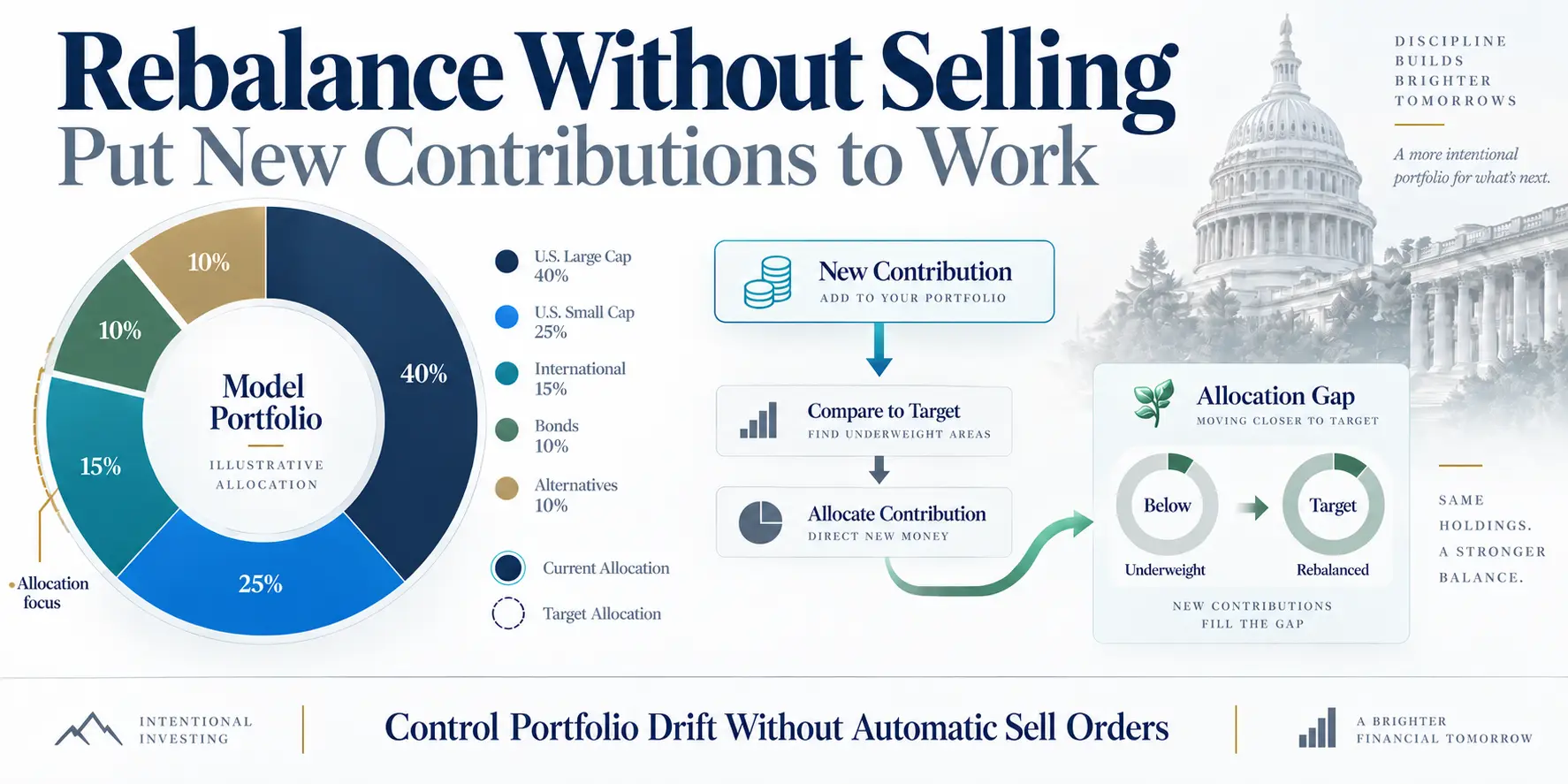
A monthly ETF contribution can do more than increase your investment balance. If directed toward positions that have fallen below their intended weights, it can also help correct portfolio drift without selling existing holdings.
For investors asking how to rebalance a portfolio without selling, the practical answer is to calculate the portfolio’s target dollar amounts after the next contribution, then direct that contribution toward the underweight investments. This is generally called cash-flow rebalancing.
It works especially well when new deposits are large relative to the portfolio’s existing allocation gaps. When the portfolio becomes much larger, however, a normal monthly deposit may no longer be enough.
This guide develops a contribution-first rebalancing method using U.S. dollar examples. It also explains when calendar-based or threshold-based rebalancing makes more sense, why taxable accounts deserve additional consideration, and how to recognize the point at which new money cannot fully restore the target allocation.
Why Selling Is Not Always the First Step in Portfolio Rebalancing
Consider an investor who originally chose a 60% stock and 40% bond allocation. If stocks subsequently outperform bonds, the stock weight might rise to 65% even though the investor never intentionally increased equity exposure.
The portfolio has drifted away from its original risk allocation.
One response is to sell some stocks and buy bonds. Another is to use incoming investment contributions to increase the bond position while leaving existing stock holdings untouched.
Both approaches can move the portfolio toward its original allocation, but their transaction and tax consequences may differ.
The Fidelity portfolio rebalancing guide identifies new contributions as one way to restore portfolio weights without necessarily selling appreciated investments.
The distinction matters in a taxable brokerage account. Selling an investment at a gain may create a taxable event. Simply purchasing additional investments generally does not realize capital gains on an existing position.
That does not mean contribution-based rebalancing eliminates every tax consideration. Dividends and other taxable distributions can still matter, and account-specific rules continue to apply.
Most importantly, rebalancing should be evaluated as a risk-management activity rather than a strategy guaranteed to increase investment returns.
How to Rebalance a Portfolio Without Selling: Step-by-Step Calculation
A frequent mistake is to invest each monthly contribution according to the original target percentages without looking at the portfolio’s existing holdings.
Suppose an investor contributes $2,000 every month to a portfolio with target weights of 60%, 20%, 10%, and 10%.
Automatically purchasing $1,200, $400, $200, and $200 of the respective investments keeps the contribution aligned with the original percentages. It does not necessarily bring the entire portfolio back to those percentages.
The correct starting point is the value of the portfolio after the new contribution is included.
Contribution-first rebalancing formula
Post-contribution portfolio value = Current portfolio value + New contribution
Target dollar value = Post-contribution portfolio value × Target weight
Required purchase = Target dollar value − Current holding value
For a fully invested portfolio with target weights totaling 100%, the required purchases will add up to the new contribution before rounding, provided the current holdings and the total value are measured consistently.
If every required purchase is nonnegative, reaching the exact targets without selling is mathematically possible under the stated assumptions.
A negative required purchase indicates that the existing holding is already above its target dollar value even after accounting for the new deposit. That holding cannot be reduced to its exact target using purchases alone.
Worked Example: How to Allocate a $2,000 Contribution
Assume an investor has a $10,000 portfolio containing four ETF holdings. The allocation has drifted slightly from the original plan.
These are hypothetical U.S.-dollar amounts, not actual historical trading records. The example assumes unchanged prices, no transaction costs or distributions, and exact-dollar purchases.
| ETF holding | Current value | Current weight | Target weight |
|---|---|---|---|
| Broad U.S. stock ETF | $6,200 | 62% | 60% |
| Bond ETF | $1,800 | 18% | 20% |
| Dividend equity ETF | $1,000 | 10% | 10% |
| Treasury bill ETF | $1,000 | 10% | 10% |
| Total | $10,000 | 100% | 100% |
After an additional $2,000 contribution, the total portfolio value becomes $12,000.
The target dollar value of the broad U.S. stock ETF is now $7,200, calculated as $12,000 multiplied by 60%.
Because the investor already owns $6,200 of that ETF, only $1,000 of additional purchases is needed to reach the target.
For the bond ETF, the target becomes $2,400. With an existing position of $1,800, the required purchase is $600.
Applying the same calculation to the remaining holdings produces the following allocation.
| ETF holding | Fixed monthly contribution | Cash-directed contribution |
|---|---|---|
| Broad U.S. stock ETF | $1,200 | $1,000 |
| Bond ETF | $400 | $600 |
| Dividend equity ETF | $200 | $200 |
| Treasury bill ETF | $200 | $200 |
| Total | $2,000 | $2,000 |
Both methods invest exactly $2,000. The difference lies in how effectively they correct the existing allocation drift.
Under the fixed-contribution approach, the broad stock ETF would finish at approximately 61.67% of the $12,000 portfolio, while the bond ETF would remain at approximately 18.33%.
Under the cash-directed approach, the broad stock and bond ETF weights reach 60% and 20%, respectively. The dividend equity and Treasury bill holdings remain at their 10% targets.
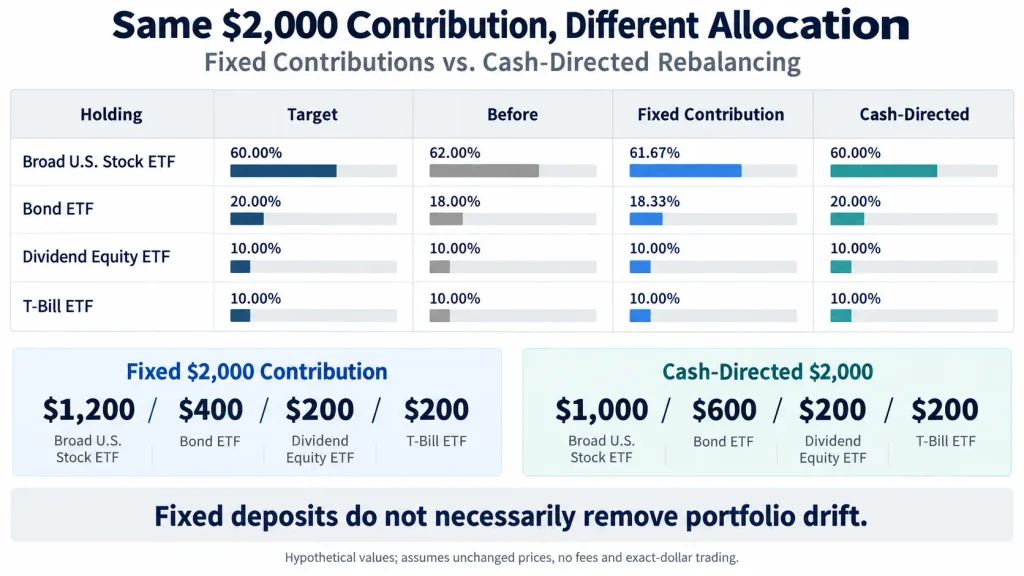
Illustration: A hypothetical $10,000 portfolio receives another $2,000. Investing the same fixed percentages preserves some allocation drift, while directing contributions toward underweight holdings restores the specified targets under unchanged-price assumptions.
This example highlights a difference between dollar-cost averaging and rebalancing.
Dollar-cost averaging specifies how money enters the market over time. Rebalancing specifies how the portfolio’s resulting exposure should be managed. A single contribution process can support both objectives, but only if existing asset values are incorporated into the purchase calculation.
When New Contributions Cannot Fix an Overweight Position
Cash-directed rebalancing has a mathematical limit. The larger the existing portfolio becomes relative to the amount being contributed, the less influence each new deposit may have on its overall allocation.
Consider a second hypothetical investor with a $100,000 portfolio.
The portfolio contains $65,000 in stocks, representing 65% of total investments. The desired stock allocation is 60%.
The investor plans to contribute another $2,000 and does not want to sell stock.
Even if the full $2,000 is invested in other assets, the stock position remains worth $65,000. The new total portfolio value becomes $102,000.
Stock weight after a $2,000 contribution
$65,000 ÷ $102,000 × 100 ≈ 63.73%
Result: The stock allocation declines from 65% to approximately 63.73%, but remains above its 60% target.
How much new cash would be required to bring that stock weight back to 60% without selling shares or purchasing additional stocks?
Assuming no change in the existing stock valuation, the calculation is:
Required new cash = Existing stock value ÷ Target stock weight − Current portfolio value
$65,000 ÷ 0.60 − $100,000 = approximately $8,333.33.
At least $8,333.34 would be required if contributions are made in whole cents and the investor wants the stock allocation at or just below 60%.
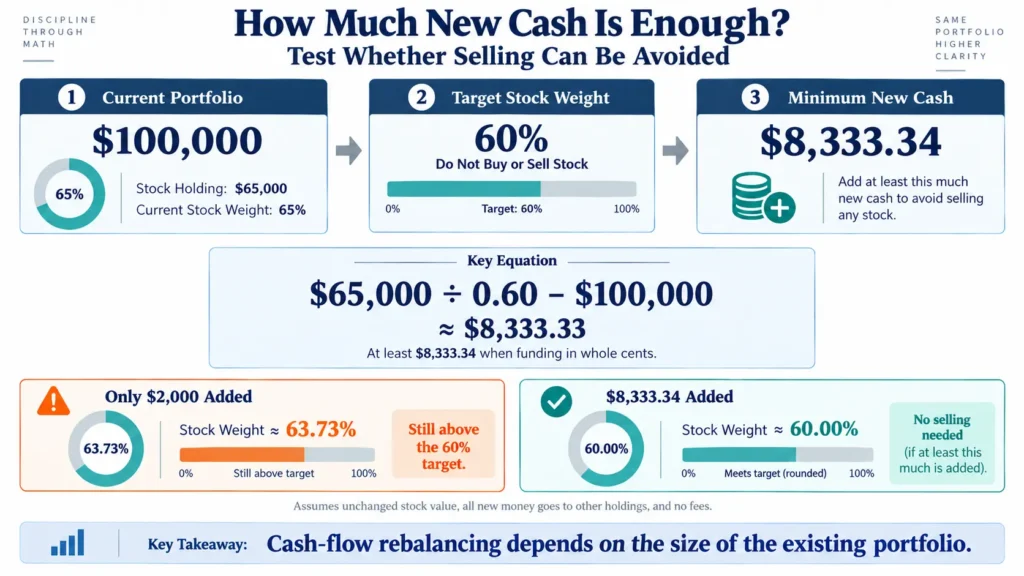
Illustration: A hypothetical $100,000 portfolio contains $65,000 in stocks. If stock prices remain unchanged and no additional stock is purchased, at least $8,333.34 in new money is required to bring the stock weight down to 60% or slightly below. Other holdings and trading constraints may require additional consideration.
This amount is the minimum required to dilute the specified stock holding to its target weight by adding money elsewhere. It does not automatically guarantee that every other holding will also finish at its intended weight.
For a portfolio with several overweight holdings, the investor must calculate the post-contribution target amount for each position. If any required purchase is negative, exact no-sale rebalancing remains impossible with the chosen contribution amount.
In practice, the investor could add more money over time, accept a temporary deviation within a predefined tolerance, or consider selective selling after evaluating taxes and transaction costs.
Calendar and Threshold Rules Still Have a Role
A contribution-first process explains how to use incoming money. It does not by itself determine when portfolio drift has become unacceptable.
That decision requires a separate monitoring rule.
The Vanguard portfolio rebalancing guide describes calendar-based, threshold-based, and combined approaches to managing allocation drift.
| Method | Main trigger | Practical consideration |
|---|---|---|
| Calendar-based | Scheduled review or adjustment | Easy to administer, but trades may occur despite minor drift |
| Threshold-based | Allocation moves outside a predefined range | Links action to drift, but requires monitoring |
| Contribution-first | New cash becomes available | Can reduce selling, but depends on contribution size |
| Combined approach | Scheduled review plus a drift threshold | Separates monitoring frequency from actual trading |
How a tolerance band changes the decision
Suppose an investor targets 60% in a stock allocation and establishes a tolerance of five percentage points on either side.
That creates an illustrative permitted range of 55% to 65%.
A stock allocation of 63% would remain within the range. At 66%, the allocation would exceed the upper boundary and call for the previously defined response.
Five percentage points is not the same as 5% of the target allocation. Five percent of a 60% target equals three percentage points, meaning a different possible upper boundary of 63%.
Because these definitions produce different triggers, the investor must specify the intended measurement before implementing the rule.
The tolerance itself should also be considered in relation to the position’s size. A five-percentage-point band around a 10% target would allow that holding to vary between 5% and 15%, a much wider relative variation than for a 60% allocation.
The specific thresholds here are examples rather than universal recommendations.
Using Contributions, Dividends, and Cash Together
New deposits are not the only cash flows that can be directed toward underweight positions.
Dividends, interest payments, and other available portfolio cash may also support the allocation process.
For example, an investor who receives ETF distributions could choose to direct those amounts toward underweight holdings instead of automatically reinvesting every payment in the fund that generated it.
This does not eliminate the underlying tax treatment of taxable distributions. It changes how the cash is subsequently invested.
A separate question is whether every available dollar should be invested immediately. Portfolio cash may serve an intended liquidity role, and an investor should distinguish that allocation from cash waiting temporarily for a trade.
Short-duration Treasury funds are one possible component of a cash-management sleeve, but they are investment products rather than FDIC-insured bank deposits. They involve their own price, liquidity, and fund-specific risks.
For a closer comparison of two widely followed U.S. Treasury bill ETFs, see Smart Asset Desk’s SGOV vs. BIL comparison. Fund characteristics and yields should be confirmed from current issuer information before making an investment decision.
A Real Contribution Record Shows Why Exact Allocations Can Be Difficult
The dollar examples above assume that an investor can purchase exactly the intended amount of every holding. Real trade execution can be less precise.
A useful illustration is Smart Asset Desk’s documented October 1, 2026 monthly investment record involving Korea-listed ETFs with U.S. equity exposure, a money market ETF, and exchange-traded spot gold.
That portfolio targeted KRW 2,000,000 in monthly purchases under a 60:20:10:10 allocation. Actual purchases totaled KRW 1,961,665, leaving KRW 38,335 uninvested.
The difference arose from the trading units of the selected products, including whole ETF shares and one-gram gold units, rather than from an attempt to predict the direction of asset prices.
The full transaction quantities and execution prices appear in the October 2026 monthly DCA portfolio update.
Two distinct issues appear in that record.
First, fixed trading increments can prevent the investor from deploying the entire intended monthly amount. Second, even if each month’s purchases closely match target percentages, the portfolio’s accumulated holdings may have different weights because their market values have changed.
These are not the same problem. The first is about execution precision. The second is about portfolio allocation drift.
Investors using U.S. brokerages that support fractional ETF shares may be able to execute dollar allocations more precisely for eligible securities. However, product eligibility and broker trading rules still need to be checked.
The broader lesson is to distinguish a desired allocation, a mathematically calculated purchase, and an actual executed transaction.
Taxable Brokerage Accounts vs. Tax-Advantaged Accounts
The account holding the investments can affect the rebalancing decision.
In a U.S. taxable brokerage account, selling appreciated securities can result in realized capital gains. Using fresh contributions may reduce the need to sell those positions merely to restore target weights.
In eligible tax-advantaged accounts, such as traditional or Roth IRAs, trading investments within the account generally does not create the same immediate capital gains tax event. Account distribution rules and other tax requirements still apply.
Fidelity’s rebalancing guidance discusses this distinction between taxable brokerage transactions and transactions within tax-advantaged accounts.
Tax treatment is only one consideration. Investors should also review transaction costs, bid-ask spreads, available cash, portfolio concentration, and whether holdings across multiple accounts should be viewed as one combined investment portfolio.
A contribution-first approach can be attractive for managing capital gains exposure, but avoiding all sales indefinitely is not necessarily the best outcome if the portfolio has moved substantially beyond its intended risk allocation.
Five Decisions Before Placing the Next ETF Order
A repeatable rebalancing process starts with a small number of decisions rather than predictions about next month’s market performance.
- Define the portfolio boundary. Decide whether the calculation covers one brokerage account, multiple investment accounts, or the entire investment portfolio. Avoid mixing figures with different scopes.
- Measure current weights using market values. Purchase cost does not determine current allocation. The relevant measure is each holding’s current value relative to the selected portfolio total.
- Calculate the next deposit against post-contribution targets. Compare each holding with the dollar amount it should represent after the new money is added.
- Check trading feasibility and permitted drift. Whole-share restrictions, insufficient cash, taxes, and transaction costs may prevent exact rebalancing. Apply a predefined tolerance rule instead of forcing unnecessary trades.
- Keep rebalancing separate from redesigning the strategy. Moving existing weights back to established targets is different from changing those targets because of a revised investment objective or risk tolerance.
Investors should also be mindful of overlapping exposure. A broad U.S. stock ETF and a dividend equity ETF are separate holdings, but both contribute to overall equity risk. Managing each holding’s target does not eliminate the need to understand the portfolio’s total stock exposure.
The U.S. Securities and Exchange Commission’s guide to asset allocation, diversification, and rebalancing provides additional background on maintaining investment allocations over time.
Questions Investors May Still Have
Can I rebalance by buying only the most underweight ETF?
Sometimes. Buying the most underweight position can move the portfolio closer to its target, but it will not necessarily bring all holdings to their exact weights. The required purchase calculation should be completed for every position. If the contribution cannot cover all gaps, the investor must decide how to prioritize the available cash.
Should I stop buying an ETF that is already overweight?
Reducing or pausing purchases of an overweight ETF is one possible contribution-first response. It is not automatically appropriate in every portfolio. The decision depends on the target allocation, the size of the available contribution, the permitted drift range, and the role that holding serves.
Does rebalancing automatically improve long-term returns?
No. Rebalancing can limit unintended concentration and help maintain a chosen risk profile, but it can also reduce exposure to investments that continue outperforming. Market returns, taxes, transaction costs, and the chosen rebalancing rules affect the eventual result. Rebalancing should not be treated as a return guarantee.
The Practical Takeaway: Measure the Gap Before Investing New Cash
For investors making recurring ETF contributions, the most useful calculation may be the amount of money each holding needs after the next deposit, not the percentage assigned to that deposit in isolation.
The $10,000 example shows that a $2,000 contribution can restore a slightly unbalanced portfolio without any sales when cash is sufficient and exact-dollar transactions are available.
The $100,000 example demonstrates the opposite limitation. A $2,000 deposit cannot fully correct a five-percentage-point stock overweight in the stated scenario. Additional contributions, a longer adjustment period, or a sale may be necessary depending on the investor’s tolerance for drift.
Calendar reviews provide a schedule. Thresholds define how much deviation is acceptable. New contributions provide a way to move allocations toward their targets with potentially fewer sales.
Used together, these elements can create a practical portfolio maintenance process without requiring an investor to trade every time market prices change.
Investment Disclaimer
This article is for educational and investment research purposes only and does not constitute a recommendation to buy or sell any security. All U.S.-dollar portfolio calculations are hypothetical illustrations. The October 2026 KRW figures are historical transaction records and should not be interpreted as current market values. Investment prices, account rules, and tax treatment may change. Investors are responsible for their own decisions and investment outcomes.